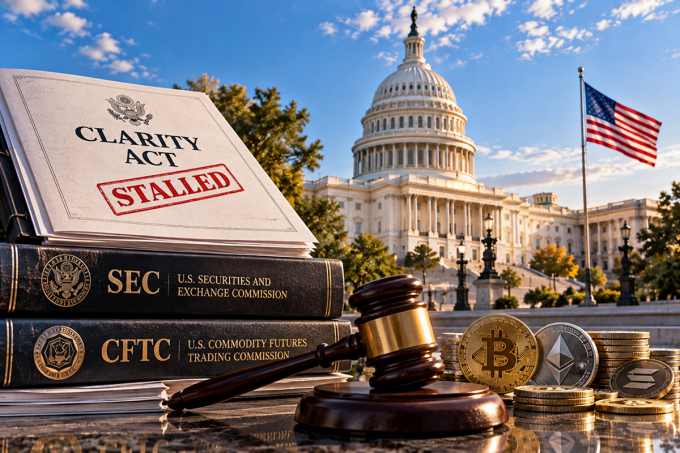
JPMorgan has urged lawmakers to implement robust safeguards as Congress advances discussions on a new crypto market structure framework, signaling that traditional finance remains cautiously supportive but deeply focused on systemic risk controls. The bank’s position highlights the growing tension between innovation-driven policy reform and the need for financial stability as digital assets become further embedded in regulated markets.
The debate comes at a pivotal moment for the crypto industry, with digital asset markets navigating a complex mix of macro uncertainty, evolving regulatory expectations, and shifting institutional participation. As lawmakers consider formalizing rules for trading, custody, and market oversight, major financial institutions are increasingly shaping the policy conversation.
Market Reaction Reflects Cautious Institutional Positioning
Crypto markets showed limited immediate directional reaction to the regulatory commentary, with Bitcoin and Ethereum continuing to trade within recent consolidation ranges. Trading volumes across major exchanges remain elevated compared to early-cycle levels, but still below prior speculative peaks, reflecting a more measured institutional footprint.
Analysts note that institutional participants are increasingly pricing in regulatory clarity as a medium-term catalyst rather than a short-term trigger. This has contributed to a market structure characterized by lower volatility spikes but sustained sensitivity to policy headlines from Washington.
Regulatory Debate Centers on Risk Controls and Systemic Exposure
JPMorgan’s messaging emphasizes concerns around leverage, custody risk, and cross-market contagion if digital assets are integrated more deeply into traditional financial systems without strict oversight. The bank has repeatedly highlighted the importance of aligning crypto market structure rules with existing securities and derivatives frameworks.
Lawmakers are weighing provisions that could define jurisdictional boundaries between the Securities and Exchange Commission (SEC) and the Commodity Futures Trading Commission (CFTC), a key issue that has long created regulatory ambiguity in the sector. Clearer definitions could reduce compliance uncertainty but may also introduce stricter operational requirements for exchanges and intermediaries.
Institutional Sentiment Balances Opportunity and Compliance Risk
Despite regulatory caution, institutional interest in digital assets remains structurally intact. Asset managers continue to explore crypto exposure through regulated products, while banks and custodians are expanding infrastructure to support tokenized and blockchain-based assets.
However, sentiment surveys suggest that compliance risk remains one of the top concerns for institutional allocators, alongside market volatility and counterparty exposure. This duality—strategic interest paired with regulatory caution—continues to define institutional behavior in crypto markets.
Outlook: Policy Clarity Could Redefine Market Structure Dynamics
As Congress moves closer to defining a formal crypto market structure framework, the balance between innovation and regulation will likely determine the next phase of market development. Stronger safeguards, as advocated by JPMorgan, may slow certain forms of market expansion but could also enhance long-term institutional confidence.
For investors, the key variable remains regulatory clarity. A well-defined framework could unlock broader capital inflows from traditional finance, while overly restrictive measures may shift activity toward offshore or less regulated venues. The coming legislative phase is therefore expected to play a decisive role in shaping crypto market architecture over the next cycle.
Comparison, examination, and analysis between investment houses
Leave your details, and an expert from our team will get back to you as soon as possible