Key Points:
- The SEC’s five-year Innovation Exemption creates a regulatory pathway for qualifying tokenized U.S. stocks to trade through automated market makers on public blockchains.
- Analysts at Goldman Sachs and Citizens identify Coinbase, Robinhood and Circle as companies with existing businesses that could benefit from growth in tokenized securities, custody and stablecoin settlement.
- The framework remains limited by trading caps, issuer objection rights and technical conditions, meaning broader adoption will depend on how the market develops under the temporary exemption.
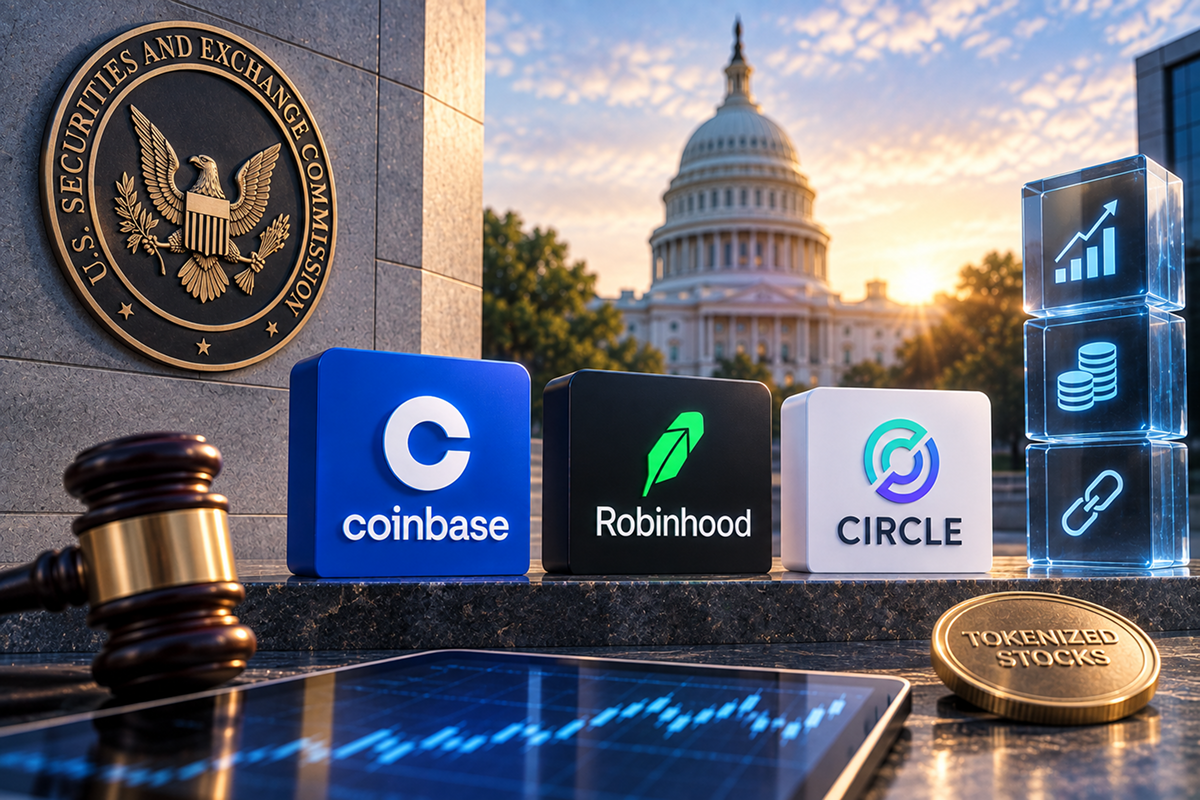
The Securities and Exchange Commission’s new framework for tokenized stocks is opening another channel between traditional capital markets and blockchain infrastructure, with analysts highlighting Coinbase, Robinhood and Circle as companies positioned to participate. The policy shift comes shortly after the Senate failed to advance the CLARITY Act, making the SEC’s temporary exemption an important near-term development for firms building onchain trading, custody and settlement infrastructure.
SEC Exemption Creates a New Market Path
The SEC’s September 17 Innovation Exemption provides qualifying Tokenized Securities Venues with temporary relief from the definition of an exchange when trading certain National Market System stocks through permissioned automated market makers and liquidity pools. The exemption lasts for five years and includes conditions intended to preserve investor protections.
Tokenized stocks must provide holders with the same rights and privileges as the corresponding traditional shares, including dividends and voting rights. Venues must also operate under limits on the number of securities and trading volume, while issuers receive an opportunity to object to third-party tokenization of their shares.
The framework therefore creates a controlled environment for experimentation rather than an unrestricted transition of U.S. equities onto public blockchains.
Coinbase Has Multiple Routes Into Tokenized Markets
Goldman Sachs analysts highlighted Coinbase because the company already operates businesses spanning tokenized assets, institutional custody and blockchain infrastructure. Its existing tokenized-equity offering reportedly incorporates several features required under the SEC framework, while Coinbase CEO Brian Armstrong has said voting rights are being added.
Citizens analysts also pointed to Coinbase’s exposure across custody, stablecoins and its Ethereum-based Base network. However, Coinbase would face an infrastructure adjustment if it sought to operate a trading venue directly under the exemption because its existing exchanges rely on central limit order books, while the SEC framework is structured around automated market makers.
That could require additional infrastructure or integration with AMM-based decentralized exchanges, creating both technical and operational considerations.
Robinhood and Circle Have Different Roles
Robinhood also has an established tokenized-equity business outside the United States, but its existing products do not necessarily satisfy the SEC’s requirements because they provide derivative-based price exposure rather than full ownership rights in the underlying shares.
Goldman analysts therefore expect additional product development before Robinhood can offer a compliant U.S. version. The company has already indicated that features including voting rights and share redemptions are being developed. The SEC framework also gives underlying issuers the ability to object before third-party tokenized shares begin trading.
Circle represents a different part of the potential infrastructure. Goldman and Citizens analysts said greater tokenized-stock activity could increase demand for USDC as a settlement and collateral asset. Coinbase could also benefit from its economic exposure to USDC and its role in distributing the stablecoin.
Traditional Exchanges Face Limited Immediate Pressure
The new framework does not necessarily imply an immediate displacement of established exchanges. Goldman analysts said Nasdaq and Intercontinental Exchange, which owns the NYSE, appear less exposed in the near term because the exemption includes trading limits, issuer opt-outs and restrictions that constrain the ability of new venues to compete directly for large volumes.
For investors, the more important question is whether temporary regulatory relief develops into durable market infrastructure. The SEC has requested public comment and indicated that the five-year exemption is intended to inform future policy. Coinbase, Robinhood and Circle each have different potential roles, but their eventual impact will depend on actual tokenized-stock volume, institutional participation, stablecoin settlement demand and the evolution of the regulatory framework.
Comparison, examination, and analysis between investment houses
Leave your details, and an expert from our team will get back to you as soon as possible