Key Points:
- U.S. Treasury Secretary Scott Bessent compared the GENIUS Act with the National Currency Act of 1863, highlighting the potential significance of stablecoin regulation for the future of the U.S. dollar.
- The GENIUS Act requires 100% reserve backing for payment stablecoins, using liquid assets such as short-term U.S. Treasuries.
- The Office of the Comptroller of the Currency published a final implementation rule on October 21, 2026, covering domestic and foreign stablecoin issuers across banking and non-banking sectors.
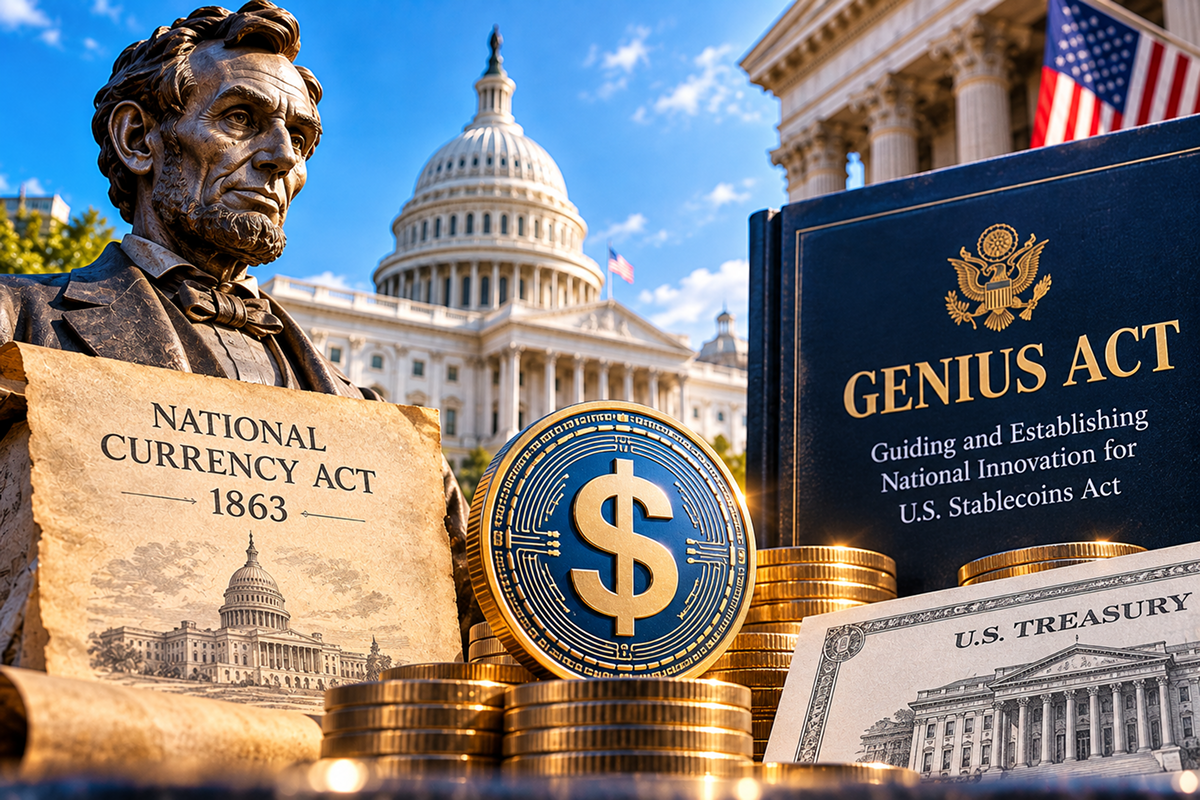
U.S. Treasury Secretary Scott Bessent has drawn a historical parallel between President Donald Trump’s GENIUS Act and legislation signed by Abraham Lincoln in 1863, placing stablecoin regulation within the broader evolution of American money. The comparison comes as U.S. authorities move to establish a regulatory framework for dollar-pegged digital assets, with potential implications for government debt demand, the payments industry and the dollar’s international role.
Why Bessent Compared Stablecoin Regulation With Lincoln’s Currency Reform
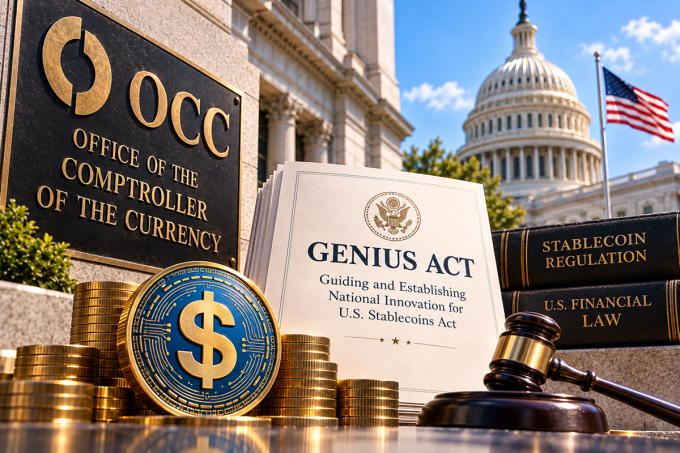
In a post on X on October 21, Bessent said the GENIUS Act further establishes the United States as the “crypto capital of the world.” The law, formally known as the Guiding and Establishing National Innovation for U.S. Stablecoins Act, was signed by President Trump in July 2025.
Bessent’s comparison invokes the National Currency Act of 1863, a landmark measure signed by Lincoln that established a federally chartered national banking system. Before the legislation, thousands of banks issued their own paper banknotes, whose values varied and which were vulnerable to counterfeiting.
The 1863 law created a framework for nationally chartered banks to issue standardized currency and established the Office of the Comptroller of the Currency (OCC) to charter and supervise national banks. The legislation was substantially revised in 1864 and became known as the National Bank Act.
The historical analogy centers on the role of regulation in shaping how money is issued and trusted. The GENIUS Act addresses a different technological and financial environment, but it similarly seeks to establish rules governing a form of money used across a broader financial system.
How the GENIUS Act Regulates Dollar-Pegged Stablecoins
Stablecoins are cryptocurrencies designed to maintain a relatively stable value by linking their price to an asset such as the U.S. dollar. A dollar-pegged stablecoin can therefore function as a digital representation of a dollar on a blockchain network.
Under the GENIUS Act, stablecoin issuers must maintain 100% reserve backing using liquid assets, including short-term U.S. Treasury securities. Reserve requirements are central to the framework because they are intended to support the ability of issuers to meet redemption obligations.
Regulatory implementation will be important for determining how issuers comply with the law in practice. Requirements governing eligible reserves, supervision and issuer obligations can influence the costs of operating stablecoin businesses and the confidence users place in dollar-pegged digital assets.
Stablecoins and Potential Demand for U.S. Government Debt
The Treasury secretary has also presented stablecoins as a potential source of demand for U.S. government debt. During congressional testimony in February 2026, Bessent argued that stablecoins could become “an important feature of financing the U.S. government.” The rationale is that growth in reserve-backed stablecoins may increase demand for assets used to support their outstanding supply, including short-term Treasury securities.
That relationship is significant for policymakers considering the intersection of digital assets and the dollar’s global role. The Trump administration views the GENIUS Act as part of an effort to reinforce the international position of the U.S. dollar, including amid efforts by countries such as China to reduce reliance on dollar-based systems.
However, the scale of any resulting Treasury demand will depend on stablecoin adoption, issuers’ reserve choices and the implementation of the regulatory framework. The law creates a structure for reserve backing, but it does not by itself guarantee a particular level of future demand for government debt.
OCC Final Rule Moves Implementation Forward
Bessent’s remarks coincided with the OCC’s publication of a final rule on October 21, 2026, concerning implementation of the GENIUS Act. According to the reported bulletin, the rule covers both banking and non-banking stablecoin issuers, including domestic and foreign entities.
The scope of implementation matters because stablecoin activity spans different types of financial institutions and operates across international markets. Clear supervisory requirements will help establish how covered issuers are expected to operate under the new framework.
For financial institutions, stablecoin companies and investors, the next stage will be assessing how the final rule translates into practical compliance obligations and market structure. The broader significance of the GENIUS Act will depend not only on its stated requirements but also on how adoption, reserve management and regulatory oversight develop over time.
Comparison, examination, and analysis between investment houses
Leave your details, and an expert from our team will get back to you as soon as possible