Key Points:
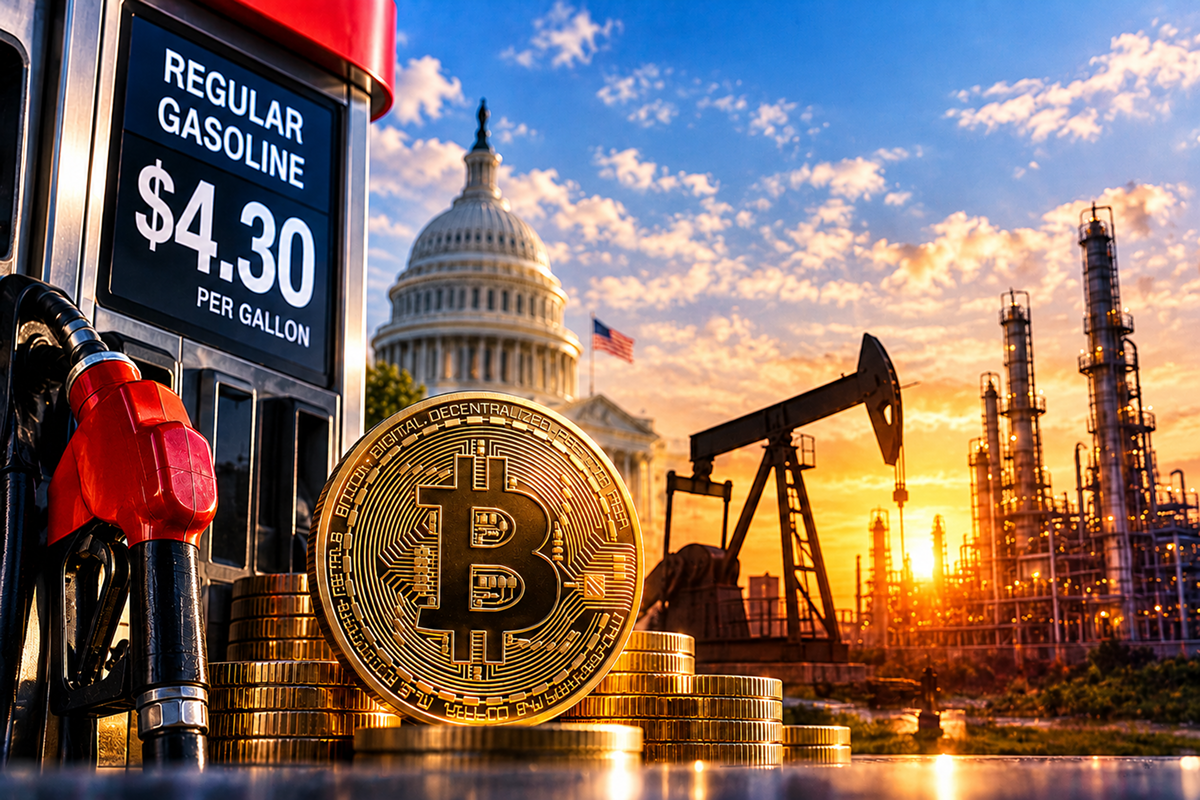
- U.S. gasoline prices reached $4.30 per gallon as of October 19, 2026, 41% above the level a year earlier, while annual CPI inflation reached 3.7% through September.
- Bitcoin gained 23% over three months but remained down 24% over 12 months, complicating the argument that the cryptocurrency reliably protects purchasing power during inflationary periods.
- Higher interest rates could pressure Bitcoin by making yield-bearing assets such as U.S. Treasuries more attractive relative to riskier investments.
Rising energy costs are renewing a central question for investors: can Bitcoin serve as a reliable hedge against inflation when geopolitical disruptions push up the price of essential goods? With U.S. gasoline prices climbing sharply and energy costs feeding into the broader economy, the cryptocurrency’s role as a potential store of value faces another test. Recent performance suggests that Bitcoin may offer exposure to changing financial conditions, but it does not necessarily protect portfolios from every type of inflation shock.
Energy-Driven Inflation Creates a Different Challenge
According to the figures cited by The Motley Fool, U.S. gasoline prices reached $4.30 per gallon on October 19, 2026, approximately 41% higher than a year earlier. The report attributes much of the increase to the continuing U.S.-Israel war with Iran and the associated disruption and destruction of oil-related infrastructure.
The broader inflation data also reflects pressure from energy. The U.S. Bureau of Labor Statistics reported that the Consumer Price Index increased 3.7% over the 12 months through September, while energy costs rose 20.4%. Core inflation, which excludes food and energy, increased 2.6% over the same period.
Energy is an input across transportation, manufacturing and other parts of the economy. Sustained increases in fuel costs can therefore raise business expenses and contribute to higher prices for goods and services. However, the extent to which those costs feed into overall inflation depends on factors including the duration of the supply disruption, consumer demand and businesses’ ability to absorb higher expenses.
Bitcoin’s Performance Does Not Establish a Reliable Inflation Hedge
Bitcoin is frequently presented as a potential inflation hedge because its supply is limited by its protocol. The argument is often associated with concerns that governments may expand the money supply and weaken the purchasing power of conventional currencies. An energy-driven inflation shock, however, presents a different challenge.
A digital asset cannot directly replace missing oil supplies or prevent fuel prices from rising. Bitcoin’s price may respond to investor expectations about inflation, monetary policy and liquidity, but those responses do not necessarily move in line with the cost of essential goods.
The performance figures cited in the report illustrate this uncertainty. Bitcoin had gained 23% over the previous three months but was still down 24% over the previous 12 months. These figures show that its performance depends heavily on the measurement period and do not support an unconditional claim that Bitcoin reliably preserves purchasing power during inflationary episodes.
The Motley Fool also references a 2023 study titled “Bitcoin Does Not Hedge Inflation,” which suggests that Bitcoin can decline during inflation scares. A separate 2024 paper by economists at the São Paulo School of Economics reportedly found that Bitcoin may have been a more effective inflation hedge earlier in its history than it has become as institutional participation has increased. These findings challenge the assumption that Bitcoin’s limited supply alone makes it a dependable short-term inflation hedge.
Why Federal Reserve Policy Matters
Energy-driven inflation can also affect Bitcoin through monetary policy. If persistent price increases lead the Federal Reserve to maintain restrictive conditions or raise interest rates, financial markets may reassess the relative appeal of riskier assets.
The article reports that the Federal Reserve raised interest rates on September 16, 2026, for the first time since 2023. It also points to elevated consumer and producer inflation readings published on October 14 and 15 as reasons markets may consider the possibility of further tightening. These developments do not guarantee additional rate increases, but they highlight the potential policy risks facing investors.
Higher interest rates can make yield-bearing assets, including U.S. Treasuries, more attractive relative to assets that do not generate contractual income. Tighter financial conditions can also reduce liquidity and weaken demand for speculative investments. Bitcoin may therefore face pressure even when inflation is rising, particularly if investors expect monetary policy to become more restrictive.
What This Means for Investors
The distinction between long-term purchasing-power protection and short-term inflation hedging is essential. Bitcoin’s limited supply may appeal to investors concerned about currency debasement over extended periods, but its market price can be volatile and sensitive to changes in risk appetite, liquidity and interest-rate expectations.
Energy inflation also differs from inflation driven primarily by monetary expansion. When the initial shock comes from a physical supply shortage, the resulting increase in fuel and transportation costs does not automatically translate into stronger demand for Bitcoin. Investors must consider the cause of inflation, the likely policy response and the behavior of other assets over the same period.
The Outlook: A Potential Diversifier, Not a Guaranteed Shield
Bitcoin’s ability to function as an inflation hedge remains dependent on the economic environment and the timeframe being considered. Its recent gains over three months coexist with a substantial 12-month decline, while rising energy costs and the prospect of tighter monetary policy create additional uncertainty.
For investors evaluating protection against inflation, the key question is not simply whether Bitcoin has a limited supply, but whether its returns consistently offset rising living costs under the conditions they face. The evidence cited in the report does not establish that consistency. Bitcoin may play a role in a diversified portfolio, but it should not be treated as a guaranteed defense against an energy-driven inflation shock.
Comparison, examination, and analysis between investment houses
Leave your details, and an expert from our team will get back to you as soon as possible