


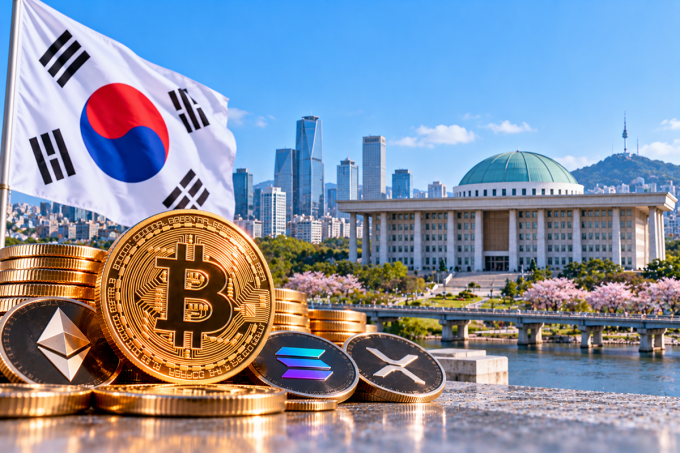
South Korean equities triggered trading curbs after benchmark indexes plunged more than 10% in a single session, reflecting a sharp risk-off move tied to escalating tensions in the Middle East. The sudden halt in one of Asia’s most liquid markets reverberated across global assets, including cryptocurrencies, which are increasingly sensitive to macro shocks and cross-asset deleveraging. For digital asset investors, the episode underscores how geopolitical risk can rapidly transmit into crypto liquidity conditions.
Market Reaction: Equities Crash, Crypto Volatility Reprices
The KOSPI Composite Index fell approximately 10.4% before volatility controls were activated, marking one of its steepest single-day declines in years. The Korean won weakened more than 1.5% against the U.S. dollar during the session, while regional equities across Asia posted losses between 2% and 4%.
In crypto markets, Bitcoin slipped roughly 3% intraday to trade near $61,500, with 24-hour volumes rising above $30 billion, suggesting active repositioning rather than a liquidity vacuum. Ethereum declined around 4%, while perpetual futures funding rates briefly turned negative, indicating a shift toward short-term hedging activity. The correlation between Bitcoin and major equity indexes has fluctuated in recent quarters, but during acute stress events, cross-asset selling pressure often emerges as leveraged participants reduce exposure.
For institutional crypto desks, the key takeaway is not the magnitude of the move, but the speed of transmission from traditional markets to digital assets.
Macro and Regulatory Implications: Liquidity as the Core Variable
South Korea represents one of the most active retail-driven crypto markets globally, frequently accounting for a significant share of altcoin spot volume. A sudden equity market freeze can tighten local liquidity, reduce risk appetite, and amplify stablecoin demand. On-chain data showed a modest uptick in USDT and USDC inflows to major Korean exchanges during the selloff, a pattern consistent with defensive positioning.
Globally, central banks are likely to monitor financial stability risks stemming from geopolitical escalation. Any shift in interest rate expectations, dollar strength, or energy prices could materially influence crypto pricing. Oil benchmarks rose more than 3% in early trading following the crisis headlines, reinforcing inflation sensitivity — a macro variable closely watched by digital asset allocators.
Crypto investors must consider how regulatory frameworks in South Korea may evolve if market volatility persists. Authorities have previously tightened oversight following extreme market swings, and additional capital controls or trading safeguards could indirectly affect digital asset flows.
Investor Sentiment: Risk-Off, But Not a Flight from Crypto
Despite the equity shock, there was no evidence of systemic crypto market stress. Stablecoin market capitalization remained broadly stable, and major exchanges reported orderly trading conditions. This suggests that while risk exposure was trimmed, capital did not exit the asset class entirely.
Psychologically, crypto markets now function as both a risk asset and a macro hedge, depending on context. In inflationary or currency-devaluation scenarios, Bitcoin often attracts defensive flows. However, in acute liquidity crunches, it can trade in line with high-beta equities. The Korean halt illustrates how narrative positioning can shift rapidly.
Strategic Outlook: Monitoring Cross-Asset Contagion and Liquidity Flows
The immediate focus for crypto investors will be whether equity stabilization measures restore confidence or if volatility spills into broader Asian markets. Key indicators include derivatives open interest, stablecoin issuance trends, dollar strength, and energy price movements.
If geopolitical tensions intensify, digital assets may face short-term volatility spikes. However, if the episode reinforces demand for decentralized, borderless financial infrastructure, medium-term structural interest could strengthen. For institutional participants, disciplined monitoring of liquidity metrics and macro signals remains central to navigating this evolving risk landscape.
Comparison, examination, and analysis between investment houses
Leave your details, and an expert from our team will get back to you as soon as possible







Leave a comment