Key Points:
- Federated Hermes, which managed $911.6 billion in assets as of June 30, 2026, plans to introduce its first tokenized fund shares in early 2027.
- The partnership with Prometheum aims to make blockchain-based fund share classes available through traditional brokerage accounts and financial advisers.
- Money market funds could be among the initial offerings, highlighting the potential role of tokenization in cash management, settlement efficiency, and institutional digital-asset infrastructure.
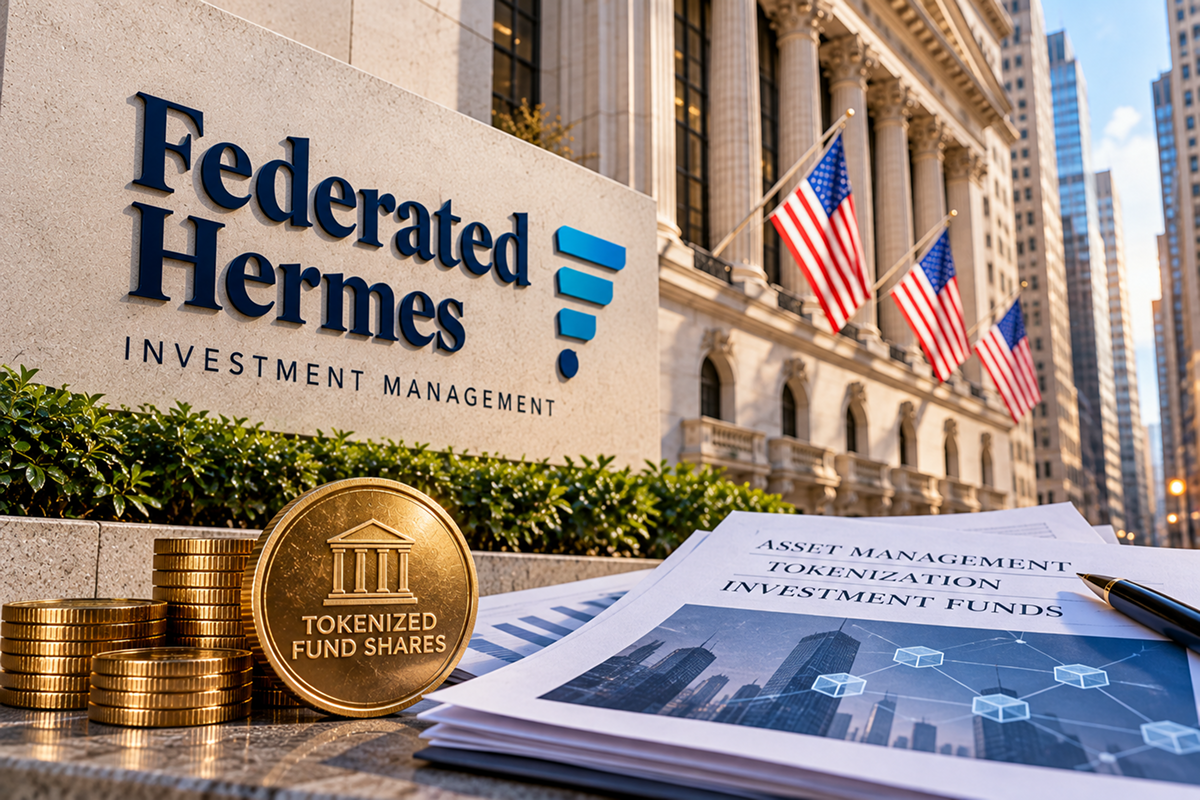
Federated Hermes is expanding its digital-asset strategy by planning to issue its first blockchain-based fund share classes in early 2027, joining a growing group of established financial institutions exploring asset tokenization. The Pittsburgh-based asset manager is partnering with Prometheum to connect tokenized investment products with conventional brokerage and advisory channels, reflecting Wall Street’s broader effort to modernize financial-market infrastructure without abandoning established distribution networks.
Institutional Tokenization Moves Beyond Digital Asset Platforms
Federated Hermes manages approximately $911.6 billion in assets, according to its October 13 announcement, giving the initiative significance beyond smaller digital-asset market participants. The company intends to issue tokenized share classes directly rather than relying exclusively on third parties to create blockchain-based representations of existing investment products.
The distinction matters because direct issuance gives the asset manager a more active role in the design and distribution of its digital securities. Federated Hermes has previously explored tokenization through arrangements involving platforms such as Archax, Goldman Sachs, and Conduit Digital. Its new initiative represents a further step toward incorporating blockchain infrastructure into its own product strategy.
The development also reflects a wider institutional trend. BlackRock, Franklin Templeton, and JPMorgan have pursued different approaches to tokenized financial products, illustrating how traditional institutions are examining blockchain technology for securities and cash-management applications. Citi has projected that the tokenized securities market could reach $5.5 trillion by 2030, although that figure remains a forecast rather than a guaranteed outcome.
Prometheum Provides Regulated Brokerage and Settlement Infrastructure
The partnership is designed to address a practical obstacle to adoption: making blockchain-based securities accessible through familiar investment channels. Prometheum’s SEC-registered, FINRA-member broker-dealer subsidiaries are expected to provide infrastructure for issuance, custody, clearing, and settlement, while its correspondent clearing platform will help other broker-dealers distribute the products.
This structure could reduce the need for participating advisers and brokerage firms to develop entirely separate systems for digital securities. Investors would potentially gain access to tokenized fund shares through established financial relationships rather than relying solely on specialist cryptocurrency platforms.
However, tokenization does not automatically eliminate regulatory, custody, liquidity, or operational risks. The practical benefits will depend on how the products are structured, which blockchain network is selected, how ownership records are maintained, and whether secondary-market access develops. Federated Hermes has not yet identified the specific funds or blockchain network planned for its initial launch.
Money Market Funds Could Establish the Initial Use Case
Money market funds are a potential starting point because liquidity management is a significant part of Federated Hermes’ business. These funds generally invest in short-term debt instruments and provide investors with a vehicle for managing cash while seeking income. The company has not formally confirmed which fund will be tokenized first.
Blockchain-based fund shares could support more efficient transfers, automated recordkeeping, and potentially faster settlement, depending on the product’s operating arrangements. Tokenized fund interests may also become useful as collateral for financing or trading, allowing institutions to deploy assets across financial applications without necessarily liquidating their underlying holdings.
For institutional investors, the strategic question is whether these efficiencies can translate into lower operational friction, broader distribution, and more flexible portfolio management. Adoption will depend on interoperability, investor protections, transaction costs, and the ability to integrate blockchain-based assets with existing financial systems.
Looking ahead, the planned first-quarter 2027 launch will provide an important test of whether a major traditional asset manager can bring tokenized fund shares into established brokerage channels at scale. Investors will monitor the selection of the initial funds, the chosen blockchain infrastructure, regulatory implementation, and the availability of secondary-market trading. If execution proves effective, Federated Hermes could help strengthen the connection between conventional asset management and blockchain-based financial infrastructure, although widespread adoption will depend on demonstrated operational benefits and sustained institutional demand.
Comparison, examination, and analysis between investment houses
Leave your details, and an expert from our team will get back to you as soon as possible