

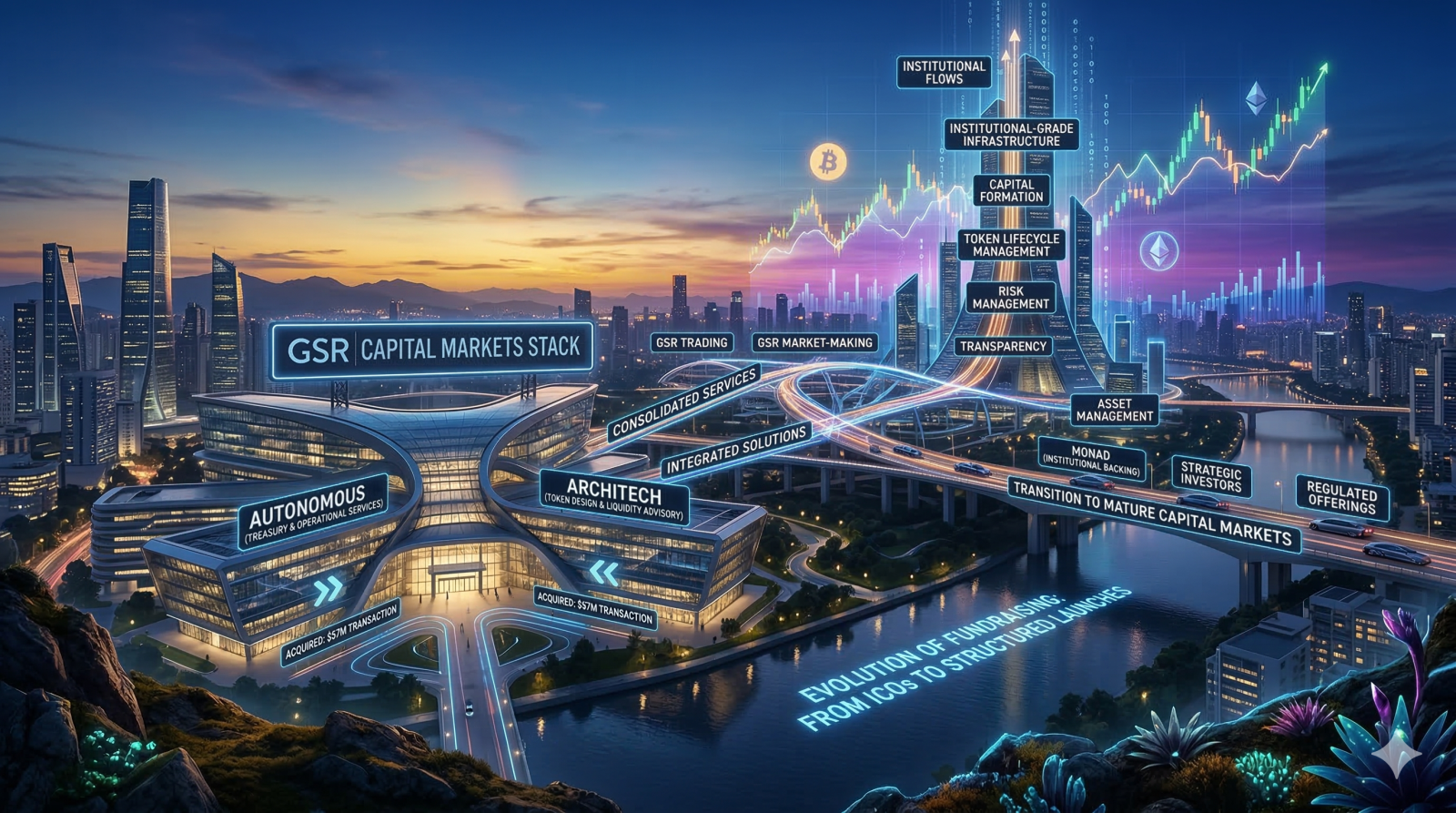
Crypto trading and investment firm GSR has acquired advisory companies Autonomous and Architech in a combined $57 million transaction, marking a strategic push to consolidate fragmented services in the digital asset ecosystem. The move reflects a broader shift in crypto markets toward institutional-grade infrastructure, as tokenized projects increasingly demand integrated solutions spanning fundraising, liquidity, and treasury management.
The acquisitions come at a time when capital formation in crypto is evolving rapidly. With Bitcoin and broader digital assets experiencing heightened volatility and institutional flows reshaping market structure, projects are seeking more coordinated approaches to token launches and financial strategy. GSR’s latest expansion positions it to capture this demand by offering a unified capital markets stack.
Building an End-to-End Crypto Capital Markets Stack
The deal brings together complementary capabilities across the token lifecycle. Autonomous contributes operational and financial services, including treasury management, exchange coordination, and capital allocation. Architech, founded in 2024, adds expertise in token design and liquidity strategy, having advised on projects with a combined peak fully diluted valuation exceeding $10 billion.
These capabilities will be integrated into GSR’s existing business lines, which include trading, market-making, and asset management. While Autonomous will continue operating under its current brand, Architech will be absorbed into a newly formed digital asset advisory unit.
The strategic rationale is clear: many crypto projects still rely on a patchwork of providers for tokenomics design, fundraising, exchange listings, and liquidity provisioning. This fragmentation often leads to inefficiencies, misaligned incentives, and execution risks. By consolidating these services, GSR aims to streamline the process and offer a more cohesive framework for project development and capital deployment.
Evolution of Token Fundraising Models
The acquisitions also reflect a broader transformation in how crypto projects raise capital. During the initial coin offering (ICO) boom of 2017–2018, projects often raised funds directly from retail investors with minimal coordination or oversight. In contrast, today’s token launches are increasingly structured, involving private funding rounds, strategic investors, and carefully managed exchange listings.
Recent examples underscore this trend. Projects like Monad raised $225 million in 2024 through institutional backing ahead of a planned token launch, while platforms such as Coinbase have introduced regulated token offering frameworks that include compliance requirements, lockups, and controlled distribution mechanisms.
These developments signal a maturation of crypto capital markets, where fundraising is no longer a standalone event but part of a broader financial strategy encompassing liquidity management, investor relations, and long-term value creation.
Investor Sentiment and Market Implications
From an investor perspective, GSR’s move highlights growing demand for institutional-grade services in digital assets. As capital allocators become more sophisticated, there is increasing emphasis on risk management, transparency, and alignment between token supply dynamics and market liquidity.
The integration of treasury services—such as liquidity planning and reserve management—into the capital markets stack is particularly significant. It suggests that projects are beginning to treat token reserves as strategic balance sheet assets rather than simply distribution mechanisms.
Psychologically, this shift may also influence investor confidence. A more structured and coordinated approach to token launches could reduce uncertainty and volatility associated with poorly executed distributions, potentially attracting a broader base of institutional participants.
Forward-Looking Perspective
GSR’s $57 million acquisition strategy underscores a critical inflection point for crypto markets: the transition from fragmented, retail-driven ecosystems to integrated, institutionally oriented capital markets. As competition intensifies, firms that can offer end-to-end solutions—from token design to liquidity management—are likely to gain a competitive edge.
Looking ahead, the success of this model will depend on execution and market conditions. Regulatory developments, liquidity cycles, and investor appetite for new token issuances will all play a role in shaping outcomes. If demand for structured token launches continues to grow, integrated platforms like GSR’s could become foundational infrastructure in the next phase of digital asset market evolution.
Comparison, examination, and analysis between investment houses
Leave your details, and an expert from our team will get back to you as soon as possible







Leave a comment