

Key Points
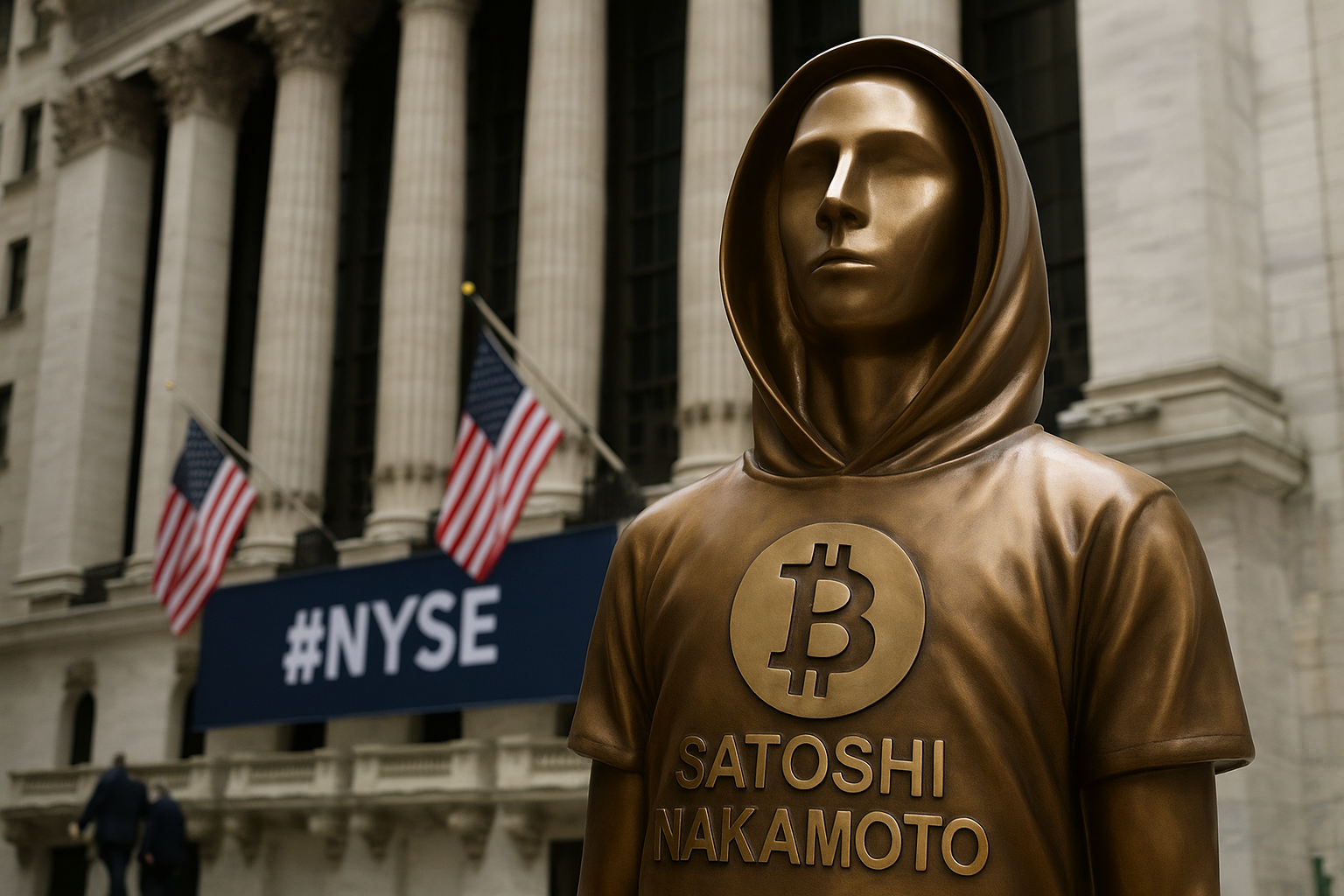
• The New York Stock Exchange unveiled a Satoshi Nakamoto statue, signaling crypto’s cultural acceptance on Wall Street.
• The work is part of Valentina Picozzi’s global series, with earlier installations in Switzerland, El Salvador, Japan, Vietnam and Miami.
• The symbolic placement reflects Bitcoin’s evolution from an outsider technology to a mainstream institutional asset.
A bronze statue honoring Bitcoin’s pseudonymous creator, Satoshi Nakamoto, now stands at the New York Stock Exchange — a once-unthinkable sight that underscores how deeply digital assets have penetrated the world’s most traditional financial institutions. Installed on Wednesday, the piece is part of a global art series by Italian sculptor Valentina Picozzi and signals how the relationship between Wall Street and crypto has evolved from skepticism to strategic embrace.
The statue’s arrival coincides with renewed institutional interest in Bitcoin, the expansion of crypto-linked financial products and the 16th anniversary of the Bitcoin mailing list, where Nakamoto first introduced the blueprint for a peer-to-peer electronic cash system.
NYSE Becomes Sixth Home for Picozzi’s “Disappearing” Satoshi
The installation, organized by Bitcoin firm Twenty One Capital, marks the sixth placement of Picozzi’s Satoshi Nakamoto statue. Other versions reside in Switzerland, El Salvador, Japan, Vietnam and Miami — all symbolic hubs of crypto innovation and adoption.
The NYSE described the new statue as “shared ground between emerging systems and established institutions,” acknowledging the convergence of traditional finance and decentralized technology. For an exchange once wary of digital assets, the gesture reflects a notable cultural shift.
Picozzi, posting under her Satoshigallery alias, called the placement “mind-blowing,” noting that “even in our wildest dream we wouldn’t think about placing the statue of Satoshi Nakamoto in this location.”
The statue’s unveiling also aligns with the anniversary of Nakamoto launching the original Bitcoin mailing list on Dec. 10, 2008 — the moment Bitcoin’s open-source development community was born.
From Cypherpunk Experiment to Institutional Asset Class
Bitcoin’s journey from peripheral curiosity to mainstream financial instrument has been rapid and often rocky. Nakamoto mined the genesis block on Jan. 3, 2009, minting the first 50 BTC and igniting what would become a trillion-dollar industry. The first documented commercial use followed in 2010, when Laszlo Hanyecz famously traded 10,000 BTC for two pizzas.
For years, Bitcoin faced resistance from governments, central banks and legacy financial institutions. Regulatory pressure peaked with initiatives such as “Operation Chokepoint 2.0,” which critics claimed sought to restrict crypto businesses’ access to the banking system.
Yet the market’s evolution has defied that resistance. Institutions increasingly treat Bitcoin as a macro asset, with spot Bitcoin ETFs now clearing billions in daily volume and major asset managers integrating digital currencies into broader strategies. The presence of Satoshi’s statue at the NYSE captures this transition — a symbolic acknowledgement that Bitcoin has become impossible to ignore.
A New Phase in Wall Street–Crypto Relations
Twenty One Capital’s trading debut at the exchange further reinforces the message: Bitcoin-native firms are no longer operating at the fringes but stepping directly onto the world’s most influential financial stage.
The statue’s arrival also reflects a strategic shift among U.S. financial institutions, many of which view blockchain and tokenized assets as unavoidable components of future market infrastructure. As regulatory clarity improves and demand for crypto investment products widens, the line between traditional markets and decentralized ecosystems continues to blur.
For investors, the symbolism may carry psychological weight. For an asset born in opposition to centralized financial power, being welcomed at the NYSE highlights how market narratives evolve as adoption deepens.
Looking Ahead: Bitcoin’s Cultural and Financial Influence Keeps Expanding
The placement of a Satoshi statue on Wall Street is more than an artistic milestone — it is a marker of Bitcoin’s irreversible integration into global finance. As digital assets gain traction among institutions, sovereign funds and policymakers, the tension between crypto’s original ethos and its modern institutionalization will continue to shape the industry.
What’s clear is that Bitcoin’s presence in mainstream finance is no longer theoretical. It now stands, quite literally, at the doorsteps of the world’s most powerful capital markets — signaling that the next chapter of crypto’s adoption may unfold far closer to Wall Street than Satoshi Nakamoto ever envisioned.
Comparison, examination, and analysis between investment houses
Leave your details, and an expert from our team will get back to you as soon as possible











SlotVIPCasino? I’m a slot guy, so this sounds promising. If you’re heavy with slots, try it slotvipcasino and see if it works for you.