

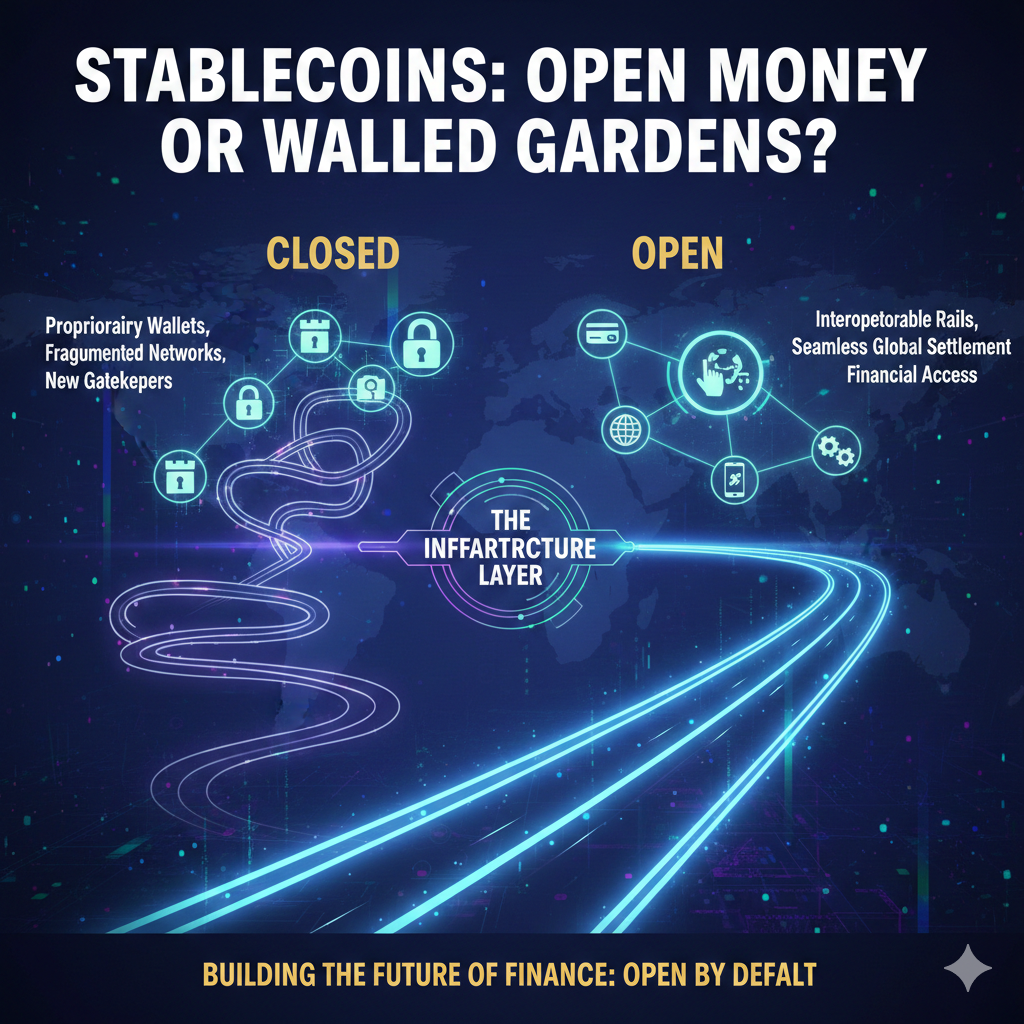
Stablecoins have emerged as one of the most transformative innovations in digital finance, promising fast, borderless, and programmable money. Yet as their adoption accelerates, a familiar challenge is emerging: the very infrastructure meant to bypass intermediaries is beginning to reintroduce bottlenecks. Industry experts warn that without open, interoperable rails, stablecoins risk becoming just another set of closed financial networks.
The Rise of Stablecoins and the Intermediary Problem
Stablecoins like USDT, USDC, and algorithmic alternatives have enabled global settlement at unprecedented speed. Transactions settle 24/7, bypass traditional bank cutoffs, and allow instant cross-border transfers. According to Citi forecasts, global stablecoin issuance could reach $1.9 trillion to $4 trillion by 2030, underscoring their potential impact on payments and financial markets.
Yet as adoption grows beyond crypto-native users into mainstream payment flows, proprietary wallets, closed ecosystems, and controlled rails are reintroducing intermediaries. Instead of eliminating friction entirely, stablecoins are shifting it “up the stack”—from settlement to usability. Businesses and consumers still face onboarding complexities, compliance requirements, wallet management, and conversion challenges. If these are not addressed openly, stablecoins risk fragmenting into siloed networks rather than functioning as open money.
Infrastructure Matters More Than Issuers
The future of stablecoins will not be determined solely by the largest issuer or fastest blockchain. Rather, the critical differentiator lies in the infrastructure layer that enables seamless routing, compliance, and settlement. Modular systems—akin to the early internet model—allow regulated fiat access, wallet interoperability, and automated routing across networks without forcing users into a single ecosystem.
For example, a São Paulo-based business paying a designer in Lagos could use stablecoins to complete the transaction instantly. However, if the system requires the designer to manage wallets, navigate private networks, or perform token conversions, then the friction and dependency on intermediaries merely shift from banks to a new class of crypto gatekeepers.
Open, standardized infrastructure ensures that stablecoins behave like internet protocols rather than closed financial networks, minimizing lock-in and enabling broader financial access. Without this approach, the benefits of speed, programmability, and borderlessness are partially nullified by new points of control.
Investor Sentiment and Market Dynamics
Investors and enterprises are already signaling a preference for interoperable and compliant stablecoin networks. Platforms that integrate with regulated fiat rails, support multiple chains, and provide user-friendly wallets are more likely to attract institutional adoption and commercial payment flows. Conversely, closed ecosystems risk alienating users seeking flexibility, cross-border reach, and seamless execution.
Analysts caution that while stablecoins scale, market concentration could replicate traditional banking bottlenecks, undermining the promise of decentralization. Observers note that the efficiency gains of stablecoins depend less on their underlying token design and more on the open, composable infrastructure that supports real-world payments.
Looking Ahead
Stablecoins are at a pivotal moment. One path leads to closed stacks that reintroduce gatekeepers and fragment the market, while the other delivers truly open, interoperable money capable of seamless global settlement. Building the infrastructure layer with openness as the default will determine whether stablecoins fulfill their promise of transforming payments and financial access or merely reinvent the intermediaries they were designed to replace.
Comparison, examination, and analysis between investment houses
Leave your details, and an expert from our team will get back to you as soon as possible












Leave a comment