

Key Points
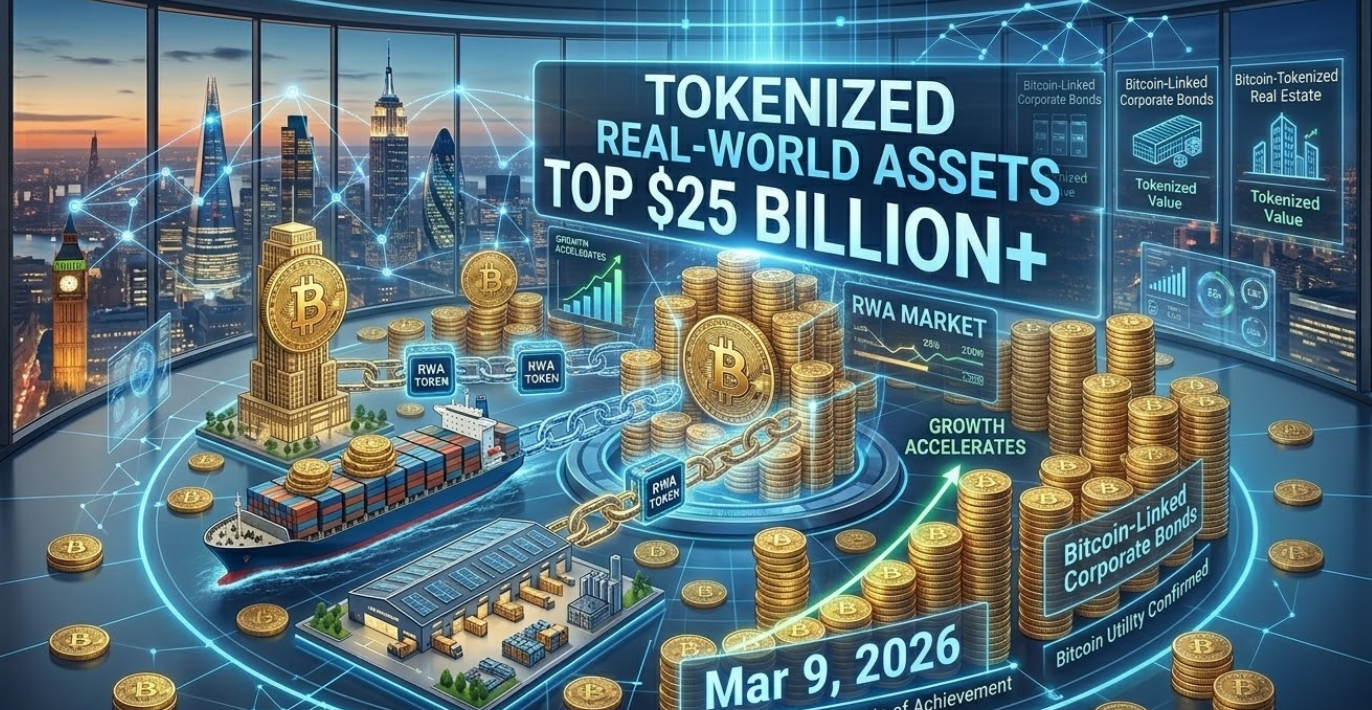
- Tokenized real-world assets excluding stablecoins have surpassed $25 billion onchain, nearly quadrupling over the past year.
- Six asset categories — including U.S. Treasurys, commodities and private credit — now exceed $1 billion each.
- Most tokenized assets remain largely isolated from decentralized finance, with only about 12% of RWA-backed stablecoins used in DeFi protocols.
Tokenized Assets Expand Rapidly
The market for tokenized real-world assets (RWAs) has crossed the $25 billion mark onchain, marking a nearly fourfold increase from about $6.4 billion a year ago.
Data from RWA.xyz shows the sector’s growth accelerating as institutional investors adopt blockchain-based infrastructure for traditional financial products.
The expansion reflects a shift from early experimentation to institutional-scale deployment, with large asset managers launching tokenized funds and securities on blockchain networks.
Major firms such as BlackRock, Fidelity Investments and WisdomTree have all introduced tokenized investment products in the past year.
Six Asset Categories Surpass $1 Billion
According to the latest data, six major categories of tokenized assets have surpassed the $1 billion threshold.
These include U.S. Treasurys, commodities, private credit, institutional alternative funds, corporate bonds and non-U.S. government debt.
Tokenized U.S. Treasury products have been among the fastest-growing segments, with the number of available offerings rising from roughly 35 to more than 50 over the past year, according to research compiled by Nexus Data Labs.
The growth highlights increasing institutional demand for blockchain-based settlement and transparency in traditional financial instruments.
Issuance Surges but Liquidity Remains Limited
Despite the rapid increase in tokenized asset supply, trading activity remains relatively limited.
Blockchain transfer data suggests that many transactions occur in large increments around $10 million, a pattern that analysts say reflects institutional capital allocations rather than continuous secondary market trading.
A survey conducted by tokenization platform Brickken reinforces this trend, showing that most issuers are focused primarily on raising capital rather than improving market liquidity.
More than half of surveyed issuers cited capital formation and fundraising efficiency as the primary motivation for tokenizing assets, while only a small portion prioritized secondary market liquidity.
DeFi Integration Still Lags Behind
Another key challenge for the sector is limited integration with decentralized finance systems.
Estimates suggest that about $8.5 billion worth of stablecoins backed by real-world assets exist onchain, yet only around $1 billion — roughly 12% — is currently deployed within DeFi lending or trading protocols.
Compliance requirements such as know-your-customer verification, transfer restrictions and investor whitelisting have kept many tokenized assets within permissioned systems rather than open blockchain markets.
A Critical Crossroads for Tokenization
The rapid growth of tokenized assets raises a central question for the industry: whether tokenization will simply replicate traditional financial infrastructure on blockchain networks or evolve into something more integrated with decentralized finance.
Some projections suggest the tokenized asset market could exceed $400 billion by the end of the year.
Whether that expansion occurs within closed institutional ecosystems or becomes fully integrated with DeFi lending, collateral and trading systems may determine the long-term structure of digital financial markets.
Comparison, examination, and analysis between investment houses
Leave your details, and an expert from our team will get back to you as soon as possible









Drive sales, earn big—enroll in our affiliate program!
Boost your income effortlessly—join our affiliate network now!