

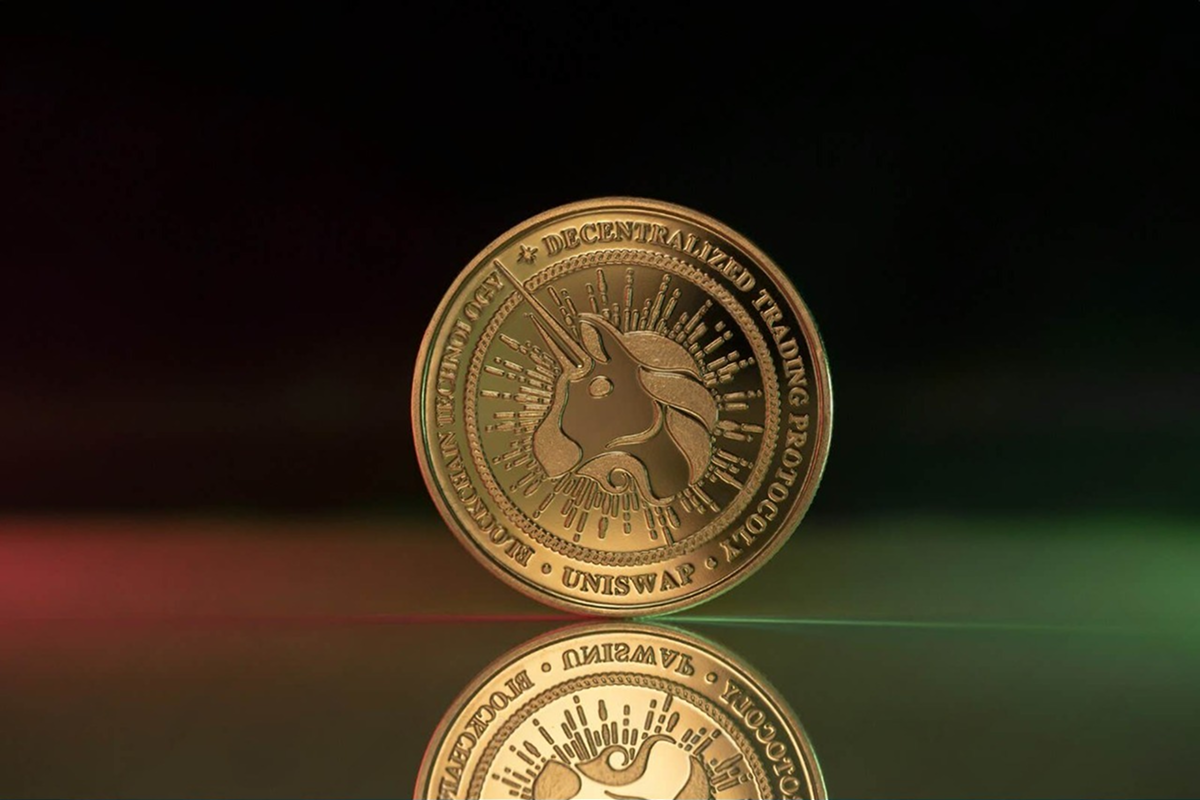
Uniswap’s UNI token jumped sharply after a long-discussed governance proposal to activate protocol fees formally entered the voting phase. The move comes amid improving risk sentiment across digital assets, as investors reassess token valuation models tied to real cash-flow mechanisms rather than pure usage metrics.
Market Reaction and Price Dynamics
UNI rallied by approximately 19% over the session, climbing from near $8.30 to above $9.85, according to aggregated exchange data. Trading volumes more than doubled relative to the 30-day average, signaling strong participation from both spot and derivatives markets.
The price reaction reflects renewed investor focus on governance outcomes that could materially alter the token’s economic profile. Historically, UNI has traded largely as a governance asset without direct revenue linkage, making the prospect of fee activation a meaningful shift in how market participants assess long-term value.
Protocol Fees and Structural Implications
The governance proposal centers on activating protocol fees, which would allow a portion of Uniswap’s trading fees to be routed to the protocol rather than solely to liquidity providers. While specific parameters remain subject to governance approval, even a modest fee share could establish a precedent for sustainable value capture within decentralized finance.
Uniswap currently processes billions of dollars in monthly trading volume across Ethereum and layer-two networks. Introducing protocol-level fees could shift UNI’s narrative toward a quasi-cash-flow token, aligning it more closely with traditional financial valuation frameworks without altering Uniswap’s non-custodial design.
Investor Sentiment and Strategic Positioning
From a behavioral perspective, the rally reflects growing appetite for tokens with identifiable economic mechanisms amid increased regulatory scrutiny. Investors appear to be rotating toward assets that demonstrate governance maturity and transparent revenue logic, particularly as macro liquidity conditions remain uncertain.
Derivatives data indicates rising open interest alongside relatively stable funding rates, suggesting positioning is not yet excessively leveraged. This implies that the move has been driven more by spot accumulation than speculative excess, a signal often associated with structurally driven repricing.
Looking ahead, the outcome of the governance vote will be closely monitored as a potential inflection point for UNI’s long-term positioning. Key risks include regulatory interpretation of fee distribution models and community pushback over liquidity incentives. Conversely, successful implementation could reinforce Uniswap’s role as a foundational DeFi protocol with a clearer economic identity, potentially reshaping how governance tokens are valued across the sector.
Comparison, examination, and analysis between investment houses
Leave your details, and an expert from our team will get back to you as soon as possible







Heard some good things about linkw88bogatafern. Just had a look now, seems reliable. Worth a try if you are a w88 fan definitely! 😉
I’ve spent a lot of time on s666xtinnude, and I can recommend it, is perfect! But take care with some links. Here is the URL s666xtinnude.