Key Points:
- Polymarket pricing cited in recent coverage placed the probability of more than 60 Senate votes for the CLARITY Act at approximately 25%, underscoring uncertainty around the bill’s path forward.
- The House passed H.R. 3633 by a vote of 294-134 on July 17, 2025, but the measure has yet to complete the Senate process.
- An August 8 cloture motion on the motion to proceed marked meaningful procedural movement, but it did not constitute Senate passage or establish the timing of a final vote.
The outlook for the Digital Asset Market CLARITY Act remains unsettled as the legislation moves through the U.S. Senate, leaving crypto investors focused on whether procedural progress can translate into the 60 votes required to advance the measure. Prediction-market pricing has offered a real-time gauge of expectations, but the divergence between market probabilities and the formal legislative record highlights the difficulty of assigning a definitive timeline to U.S. crypto regulation.
The uncertainty matters beyond Washington. A comprehensive federal framework for digital assets could influence how crypto businesses structure operations, how regulators classify tokens and how institutional investors assess regulatory risk in the U.S. market.
Polymarket Pricing Highlights the 60-Vote Challenge
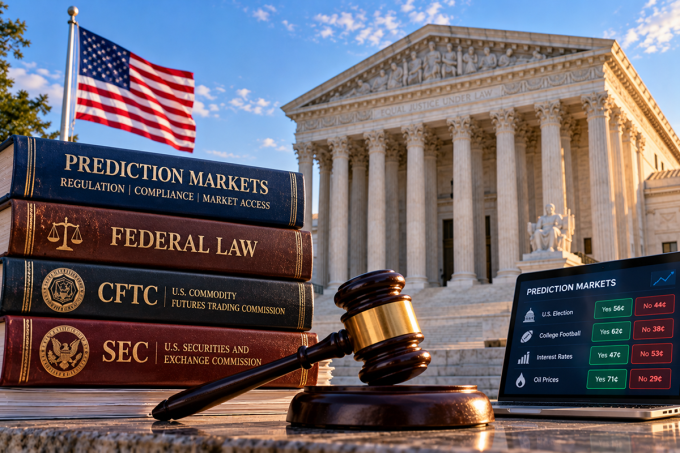
Recent reporting cited Polymarket odds of approximately 25% for the CLARITY Act receiving more than 60 Senate votes. That threshold is particularly important because legislation generally needs 60 votes to overcome a Senate filibuster and advance through the chamber under the procedural framework currently surrounding the measure.
Polymarket’s prediction markets provide a market-based assessment of expectations rather than an official legislative forecast. The pricing can change rapidly as traders respond to statements from lawmakers, procedural developments and negotiations over controversial provisions. As a result, the probability should be viewed as a sentiment indicator rather than evidence that the Senate will ultimately approve or reject the legislation.
Other Polymarket contracts have shown different probabilities depending on the precise question and resolution criteria, reinforcing the importance of distinguishing between a procedural vote, a final-passage vote and enactment into law.
House Passage Does Not Guarantee Senate Approval
The House passed H.R. 3633, the Digital Asset Market CLARITY Act, on July 17, 2025, by a substantial 294-134 vote. The result demonstrated considerable bipartisan support in the House, but the Senate presents a different political and procedural environment.
The bill is associated with the Senate Banking, Housing, and Urban Affairs Committee, while negotiations remain important to determining whether enough senators can support the legislation. Differences over issues including decentralized finance, stablecoin-related provisions, consumer protections and restrictions involving government officials have contributed to the uncertainty surrounding the Senate process.
For crypto markets, the distinction between House approval and completed federal legislation is material. Until both chambers approve the relevant legislative text and the measure completes the remaining steps required to become law, regulatory clarity remains prospective rather than established.
Cloture Step Advances the Process, Not the Bill Itself
The Senate’s August 8, 2026 cloture motion on the motion to proceed represented an important procedural development. However, a cloture motion should not be interpreted as Senate passage. It indicates movement within the legislative process but does not determine whether the underlying legislation will ultimately receive enough support on final passage.
The timing is also significant because the Senate’s remaining legislative calendar is constrained by the approaching November 2026 midterm elections. A prolonged negotiation could reduce the available window for completing the bill and increase the importance of bipartisan agreement.
For institutional crypto investors, the next signals to watch are Senate negotiations, the scheduling of a substantive vote, the final legislative text and the number of senators publicly supporting the measure. The CLARITY Act could establish a more defined regulatory framework for digital assets, but prediction-market optimism alone cannot substitute for congressional votes. Until the Senate completes its process, regulatory uncertainty remains a meaningful variable for U.S. crypto markets and the businesses operating within them.
Comparison, examination, and analysis between investment houses
Leave your details, and an expert from our team will get back to you as soon as possible