Key Points:
- Prediction markets face an expanding legal and regulatory dispute, with industry participants, state authorities and federal regulators seeking clarity from the U.S. Supreme Court.
- Amicus briefs, a proposed federal rule and an interim final rule reflect competing approaches to oversight of event-based contracts.
- The outcome could reshape market access, compliance obligations and competition for platforms offering contracts linked to sports, politics and other real-world events.
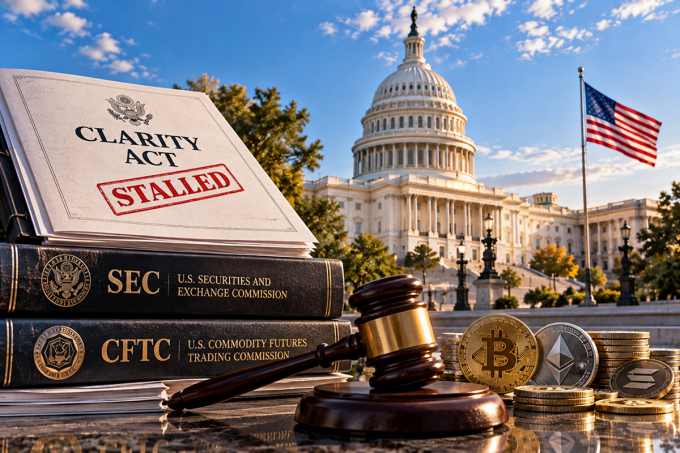
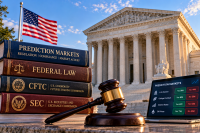
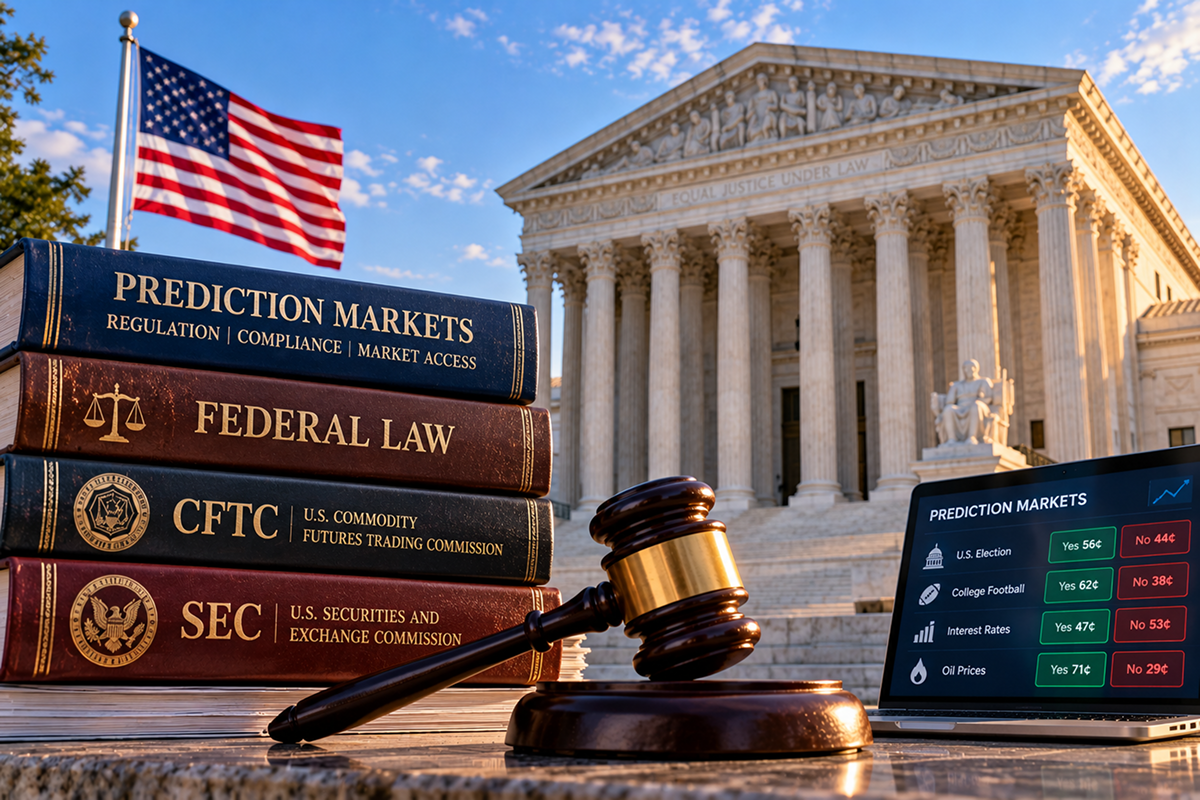
The U.S. Supreme Court has not yet indicated whether it will hear cases challenging the regulatory treatment of prediction markets, but pressure for judicial clarity is growing. Multiple amicus briefs, alongside federal rulemaking activity, underscore a dispute over whether event-based contracts should primarily fall under federal derivatives oversight or state gambling laws—a question with significant implications for crypto-connected trading platforms and financial-market infrastructure.
A Legal Dispute With National Implications
Prediction markets allow participants to trade contracts whose payouts depend on whether a specified event occurs. These products can cover sports results, elections and other measurable outcomes. Their rapid expansion has created a jurisdictional conflict: operators argue that certain contracts qualify as financial derivatives under federal law, while state authorities have sought to restrict products they consider unlicensed gambling.
The disagreement has become more consequential as courts have reached conflicting conclusions in disputes involving platforms such as Kalshi. Differing interpretations create uncertainty for companies seeking to offer products across state lines. A Supreme Court review could help resolve important questions about the relationship between federal commodity law and state gambling restrictions, although the Court has not committed to hearing the cases.
For market participants, the immediate challenge is operating across a fragmented legal landscape. A product permitted under one interpretation may face restrictions under another, complicating compliance planning, product design and nationwide expansion.
Amicus Briefs Put Competing Interests Before the Court
The growing number of amicus briefs reflects the range of interests affected by the dispute. These filings allow organizations and other parties that are not directly involved in a case to present legal arguments or explain the broader consequences of a potential ruling. Their involvement signals that the question extends beyond individual platforms to the allocation of regulatory authority across the financial and gambling industries.
For prediction-market operators, federal oversight can offer a framework for designing products and managing compliance, but it does not necessarily eliminate state-level challenges. State regulators, meanwhile, have an interest in preserving their authority over gambling-related activity within their jurisdictions. The competing positions leave businesses weighing the benefits of a nationally consistent framework against the possibility of continued restrictions and litigation.
The commercial stakes are meaningful even without a confirmed Supreme Court hearing. Uncertainty can affect the timing of product launches, the willingness of institutional partners to participate and the resources companies must devote to legal compliance. It can also influence competitive dynamics, as larger operators may be better equipped to navigate prolonged disputes.
Federal Rulemaking Adds Another Layer
Judicial proceedings are unfolding alongside regulatory action. The existence of an interim final rule and a separate proposed rule demonstrates that federal authorities are also attempting to establish how prediction-market contracts should be treated under existing law. These measures form part of a broader effort to define the boundary between financial derivatives regulation and state gambling oversight.
However, rulemaking and judicial review serve different purposes. Agency measures can establish requirements within a regulator’s legal authority, while courts determine how relevant statutes apply and whether particular exercises of authority are lawful. Even additional federal guidance may leave unresolved questions about the interaction between national rules and state restrictions.
For crypto-related platforms, the distinction is especially relevant where event contracts operate alongside digital-asset trading. Regulatory clarity could support more predictable business planning, but it would not automatically exempt every product from state laws or other applicable requirements.
What Market Participants Should Watch
The next developments include whether the Supreme Court agrees to hear the pending disputes, how federal rulemaking progresses and whether further court decisions deepen or narrow the existing legal differences. A consistent and legally durable framework could reduce uncertainty for operators and their institutional partners, while continued disagreement may preserve barriers to nationwide expansion. Until the legal position becomes clearer, prediction-market businesses will need to account for regulatory overlap, litigation exposure and changing compliance requirements when evaluating growth opportunities.
Comparison, examination, and analysis between investment houses
Leave your details, and an expert from our team will get back to you as soon as possible