Key Points:
- The Senate’s 2:15 p.m. ET procedural vote on September 15 requires 60 votes to advance the CLARITY Act, making bipartisan support the immediate test for the legislation.
- Democratic objections and banking-sector opposition remain unresolved despite a revised 635-page draft containing 126 changes requested by Democrats and new ethics provisions.
- Analysts remain focused on $80,000 for Bitcoin, $3,000 for Ethereum and $4 for XRP, but those levels depend on regulatory progress and a broader improvement in crypto market conditions.
CLARITY Act Reaches Its Most Important Senate Test
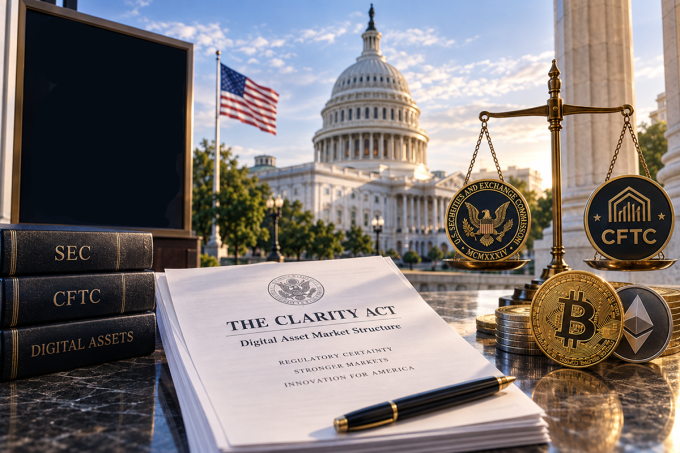
The U.S. Senate faces a pivotal test for cryptocurrency regulation on September 15 as lawmakers prepare to vote on whether to advance the CLARITY Act. The procedural vote requires 60 senators, meaning the legislation must attract meaningful bipartisan support at a time when disagreements over ethics rules, stablecoins and banking-sector protections remain unresolved.
The timing is particularly significant for digital-asset markets because the vote comes alongside heightened macroeconomic uncertainty. Bitcoin recently recovered toward the $80,000 area, while Ethereum traded near $2,600 and XRP around $1.48 in the latest market snapshot, leaving investors to assess whether regulatory clarity can offset broader pressure from monetary policy expectations.
Revised Bill Attempts to Address Democratic Concerns
Senate Republicans released a 635-page revised draft on September 14, describing it as a final proposal ahead of the vote. Senators Cynthia Lummis, John Boozman and Tim Scott said the text incorporates 126 substantive changes requested by Democrats, covering areas including ethics, enforcement and financial stability.
The revised language also follows a last-minute concession from President Donald Trump concerning restrictions on covered federal officials and their spouses holding significant crypto interests or issuing digital assets. State attorneys general would receive an expanded enforcement role. However, Democratic lawmakers continue to argue that the provisions contain too many exceptions and may not sufficiently address conflicts involving politically connected crypto interests.
For institutional investors, the dispute matters because the CLARITY Act is designed to establish clearer boundaries around digital-asset regulation. Failure to advance the bill would preserve uncertainty over regulatory responsibilities and could delay some forms of institutional market development.
Banking Groups Add Another Obstacle
The legislation is also facing opposition outside Congress. Eight banking trade groups have criticized a stablecoin provision intended to protect community banks if customers shift deposits into reward-bearing payment stablecoins.
The proposed mechanism would allow regulators to respond if stablecoins create substantial deposit-flight risks for smaller banks. Banking groups argue that the measure does not provide sufficient protection, highlighting a broader conflict over whether stablecoins should be treated primarily as payment infrastructure or as products that could compete directly with traditional bank deposits.
That debate has wider implications for crypto adoption. Stablecoins are increasingly integrated into payments, trading and institutional settlement, meaning their regulatory treatment could influence how banks, exchanges and financial institutions participate in digital-asset markets.
Price Targets Remain Constructive Despite Political Risk
The political uncertainty has not eliminated bullish market scenarios. Bitcoin’s $80,000 level, Ethereum’s $3,000 threshold and XRP’s $4 target remain important reference points for analysts assessing the potential impact of regulatory progress.
These targets should not be interpreted as guaranteed outcomes. Bitcoin’s ability to sustain momentum near $80,000 would depend on broader liquidity and interest-rate conditions, while Ethereum reaching $3,000 would require continued relative strength beyond Bitcoin. XRP carries a more direct regulatory sensitivity because clearer statutory treatment could materially reduce uncertainty surrounding its market classification and institutional participation.
What the Market Is Watching Next
The immediate catalyst is the September 15 procedural vote. If the bill secures 60 votes, the market will shift toward the substance of subsequent negotiations and the path toward final passage. If it fails, the regulatory timeline becomes substantially less certain. Investors will therefore be watching not only the vote itself but also Bitcoin’s ability to hold near $80,000, Ethereum’s move toward $3,000 and whether XRP can sustain momentum toward $4 as the market weighs regulatory clarity against persistent macroeconomic risks.
Comparison, examination, and analysis between investment houses
Leave your details, and an expert from our team will get back to you as soon as possible