Key Points:
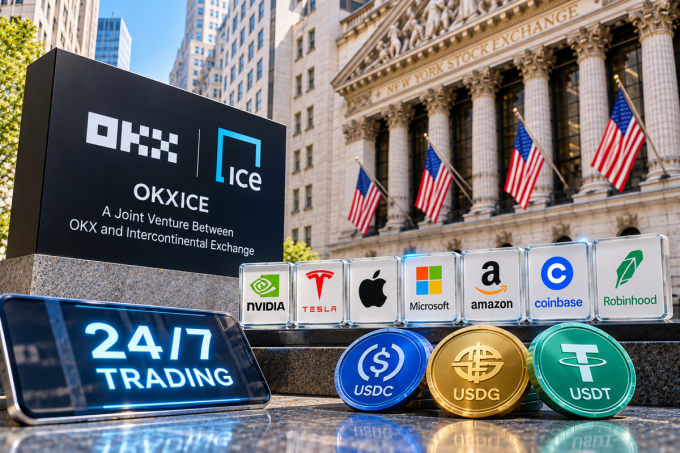
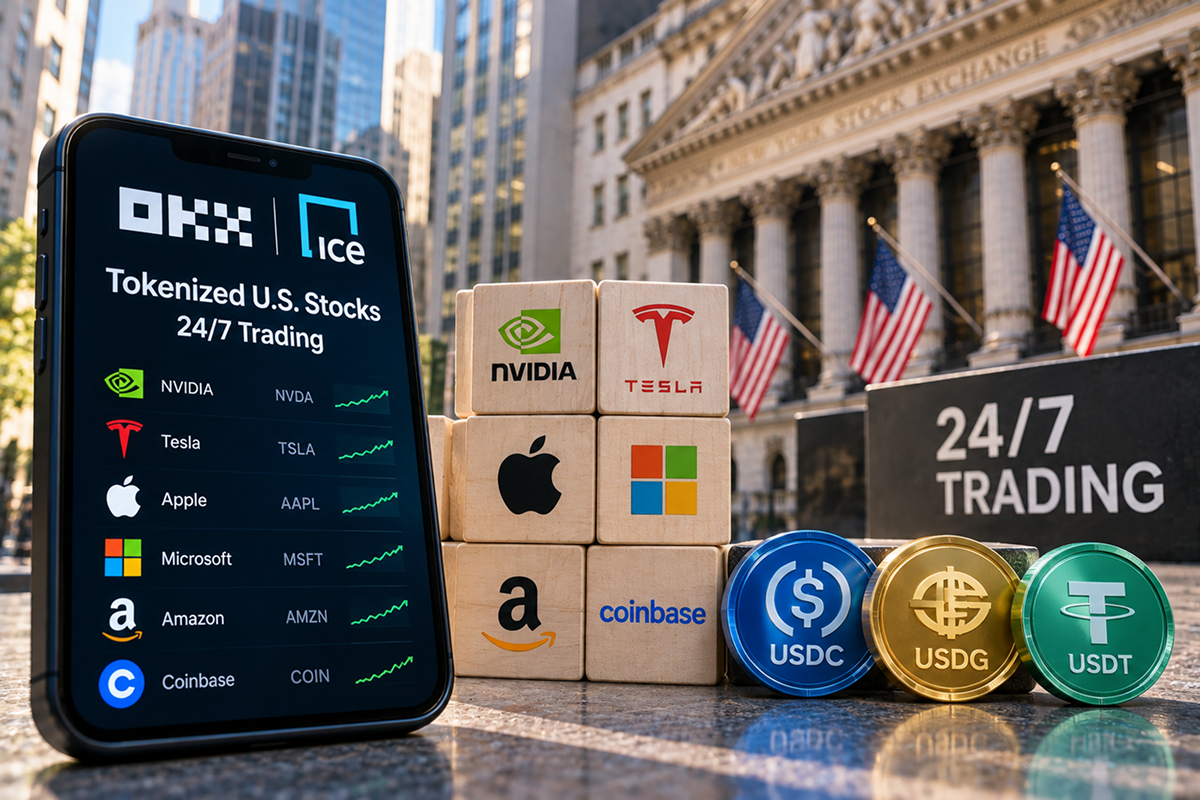
- OKXICE, a joint venture between OKX and Intercontinental Exchange, plans to offer 63 tokenized U.S. stocks, including Nvidia, Tesla, Apple and Coinbase, through a 24/7 blockchain-based trading venue.
- The proposed market would use USDC, USDG and USDT as trading pairs and automated liquidity pools rather than a conventional stock-exchange order book.
- The initiative arrives as tokenized equities reached a record $4.45 billion in August, indicating that blockchain-based securities are becoming a more meaningful part of digital-asset market infrastructure.
U.S. equities are moving deeper into blockchain infrastructure as OKXICE, a 50-50 joint venture between crypto exchange OKX and Intercontinental Exchange, plans a 24/7 venue for tokenized shares of more than 60 U.S.-listed companies. The proposed platform would combine traditional securities with stablecoin settlement and blockchain-based liquidity pools, creating a market structure that could extend equity trading beyond conventional exchange hours.
63 Stocks Could Move Into a 24/7 Market
The notice dated October 4 lists 63 stock tokens, including Nvidia, Tesla, Apple, Microsoft, Amazon, JPMorgan, Goldman Sachs and several crypto-related companies such as Coinbase, Robinhood and Circle. Each token would trade against one of three stablecoins: USDC, USDG or USDT.
The significance for crypto investors is the potential merging of two previously separate liquidity pools. Instead of moving between a crypto exchange and a traditional brokerage, market participants could eventually access tokenized equities alongside digital assets through blockchain infrastructure. OKX already launched more than 40 tokenized U.S. stocks and ETFs internationally in July, although those products are not currently available to U.S. or European customers.
Why Liquidity Pools Matter
The proposed venue would differ from a traditional exchange because trades would occur through automated market-maker liquidity pools rather than a conventional central limit order book. Liquidity providers would deposit assets into smart-contract-based pools, with algorithms determining prices based on the assets available in each pool. The SEC’s September innovation exemption specifically created a framework for permissioned tokenized-stock venues using AMM liquidity pools.
That structure could make markets more flexible, but it also changes the way liquidity and execution risk are managed. For institutional investors, the key questions will include spreads, depth, price discovery, settlement reliability and how closely token prices track their underlying shares.
Tokenized Equities Are Already Growing
The proposed platform enters a market that has already expanded substantially. CoinDesk Research reported that the tokenized equity market reached $4.45 billion on August 26, after growing 11.3% during the month. Tokenized real-world assets overall reached a record $34.7 billion, while stablecoin market capitalization rose to $311 billion in August.
Those figures matter because tokenized stocks require more than blockchain technology. They depend on stablecoins for settlement, compliant custody arrangements, reliable price feeds and sufficient liquidity. The expansion of each layer can reinforce the others, creating a broader onchain financial ecosystem rather than an isolated crypto product category.
The Regulatory Framework Is Becoming the Critical Layer
The SEC’s September order provides temporary conditional relief for certain distributed-ledger trading venues and liquidity providers dealing in tokenized NMS stocks. The framework is designed to permit permissioned trading while allowing regulators to observe how the technology works in practice.
For crypto investors, the next milestone is therefore not simply the number of stocks offered but whether the model can achieve institutional-grade liquidity, regulatory compliance and reliable price discovery. A successful launch could demonstrate that blockchain infrastructure can support mainstream securities markets around the clock. If liquidity remains fragmented or regulatory constraints limit participation, adoption could develop more slowly.
The proposed OKXICE venue represents a significant test of whether tokenization can move from an investment narrative into functioning market infrastructure. The combination of 63 major U.S. companies, stablecoin settlement and 24/7 trading could create new demand for blockchain-based financial rails. For crypto markets, the longer-term significance may be less about tokenized Nvidia or Tesla shares themselves and more about whether traditional capital markets increasingly settle and trade through the same infrastructure that already powers digital assets.
Comparison, examination, and analysis between investment houses
Leave your details, and an expert from our team will get back to you as soon as possible