Key Points:
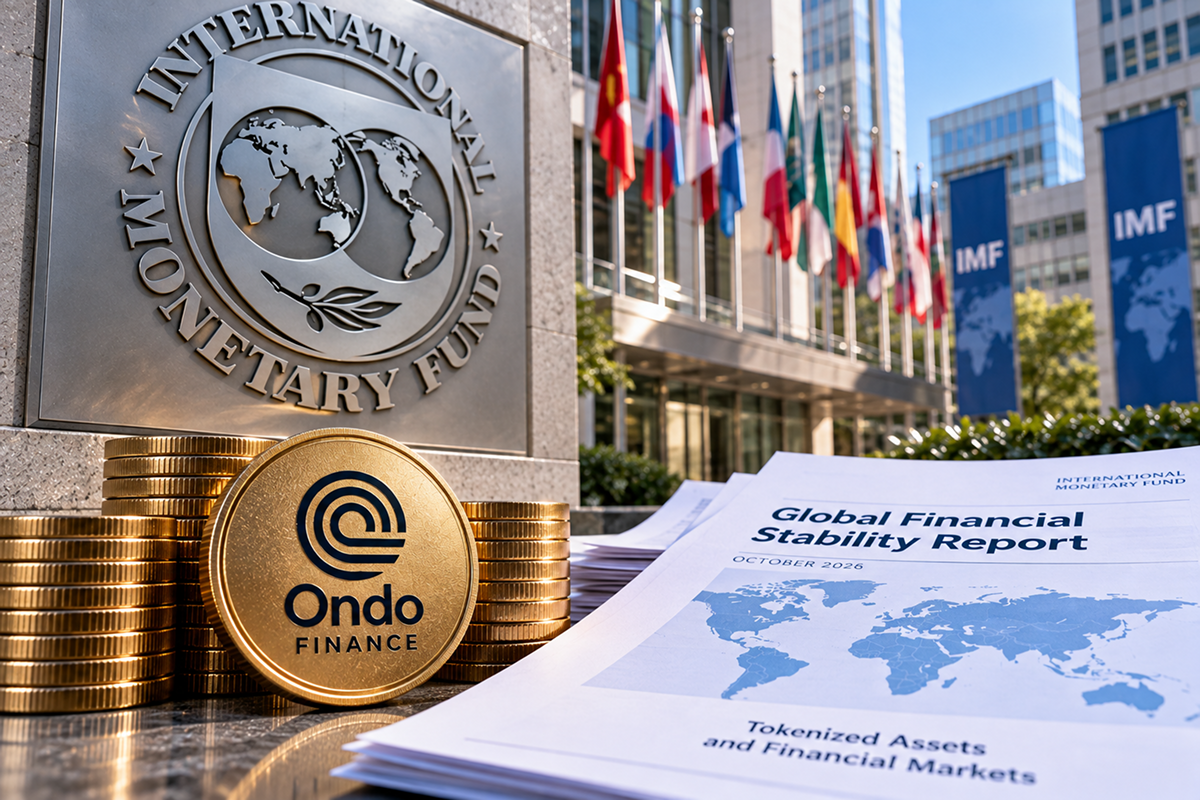
- Ondo Finance appears among the individually identified platforms in the IMF’s October 2026 Global Financial Stability Report chapter on tokenized markets.
- Tokenized repurchase agreements average $300 billion to $350 billion in daily transaction volume, while other tokenized assets contribute approximately $65 billion daily.
- Legal uncertainty, regulatory clarity, interoperability, and settlement infrastructure remain major barriers to adoption, with the IMF warning that tokenization could amplify financial stability risks as markets scale.
Ondo Finance has gained recognition in the International Monetary Fund’s (IMF) assessment of the expanding tokenized asset market, appearing alongside Securitize, Circle, Tether Holdings, and Bridgetower in the institution’s October 2026 Global Financial Stability Report. The report highlights the growing use of blockchain-based financial products while emphasizing that tokenization remains small relative to traditional financial markets and faces significant legal, regulatory, and operational challenges.
Ondo’s Position Highlights the Expansion of Tokenized Finance
Ondo Finance develops blockchain-based financial products that provide access to traditional assets, including yield-bearing tokens backed by U.S. Treasuries, such as USDY, and tokenized representations of publicly traded stocks through Ondo Stocks. Its inclusion among the platforms individually identified by the IMF reflects its presence in an increasingly diverse market for tokenized financial instruments.
The IMF’s chart draws on RWA.xyz data and the institution’s own calculations. Alongside Ondo, it identifies Securitize, Circle, Tether Holdings, and Bridgetower, while grouping more than 50% of the market under the category “Other.” This distribution underscores the fragmented structure of tokenized finance, where numerous platforms operate across different assets, networks, and financial applications.
Ondo’s inclusion should not be interpreted as an IMF endorsement or a formal ranking of platform quality. Rather, it places the company within the report’s broader assessment of the participants shaping tokenized markets. For institutional investors, the distinction between market presence and demonstrated long-term adoption remains important.
Tokenized Markets Grow but Remain Small Relative to Traditional Finance
The IMF estimates that tokenized repurchase agreements generate approximately $300 billion to $350 billion in daily transaction volume. Other tokenized assets, including credit instruments, money market funds, and equities, contribute approximately $65 billion in daily activity.
These figures indicate that tokenization is already supporting meaningful financial activity. However, the scale remains modest compared with traditional markets. The U.S. repo market alone handles approximately $13 trillion in daily transactions, while global capital markets represent roughly $300 trillion in assets.
The report also identifies potential structural advantages. More than 50% of tokenized equity trading occurs outside traditional market hours, suggesting demand for extended trading access. Additionally, approximately 80% of analyzed tokenized equity trades were smaller than the price of a single share, highlighting the role of fractional ownership in making securities more accessible through blockchain-based systems.
Legal and Operational Barriers Remain Significant
Despite these developments, the IMF identifies four principal constraints on wider adoption: legal certainty, regulatory clarity, interoperability, and settlement using reliable forms of money. Investors and institutions need confidence that tokenized assets represent enforceable ownership rights and that existing financial regulations apply clearly to the products and platforms involved.
Interoperability presents another challenge because separate blockchain platforms can create isolated liquidity pools. Without effective connections between systems, tokenization may reproduce existing market fragmentation rather than deliver seamless transfers and settlement. The availability of widely accepted settlement assets is equally important for ensuring that transactions can be completed reliably.
The IMF also warns that scaling tokenized markets could amplify traditional financial vulnerabilities, including fire sales, liquidity runs, and contagion. Faster settlement and automated transactions may reduce administrative friction, but they could also remove delays that currently provide institutions with time to reconcile positions and respond to market stress.
Looking ahead, Ondo Finance and other tokenization platforms will be judged by their ability to convert technological adoption into durable institutional participation. Progress in legal recognition, regulatory coordination, interoperability, and settlement infrastructure will help determine whether tokenized financial products can expand beyond specialized applications. For crypto investors, the central question is whether blockchain-based markets can deliver measurable efficiency gains while preserving the safeguards required for financial stability.
Comparison, examination, and analysis between investment houses
Leave your details, and an expert from our team will get back to you as soon as possible