Key Points:
- Elice shares fell more than 30% below their IPO price despite retail demand exceeding the available allocation by more than 400 times, intensifying questions about valuations in AI infrastructure.
- South Korea’s KOSPI declined nearly 4%, while CoreWeave fell 3% in U.S. premarket trading as investors reassessed the costs and profitability of AI infrastructure expansion.
- Brent crude climbed above $111 per barrel, its highest level since May, adding energy-market uncertainty linked to concerns about Middle Eastern supply disruptions and shipping risks.
Investor confidence in artificial intelligence infrastructure faced renewed pressure on October 20, 2026, after South Korean data center company Elice suffered a sharp decline following its stock market debut. The sell-off coincided with weakness across South Korean equities and continued declines in U.S. premarket technology shares. Meanwhile, rising crude oil prices added another source of uncertainty, highlighting the competing pressures facing global financial markets.
Elice’s Debut Challenges Expectations for AI Infrastructure Valuations
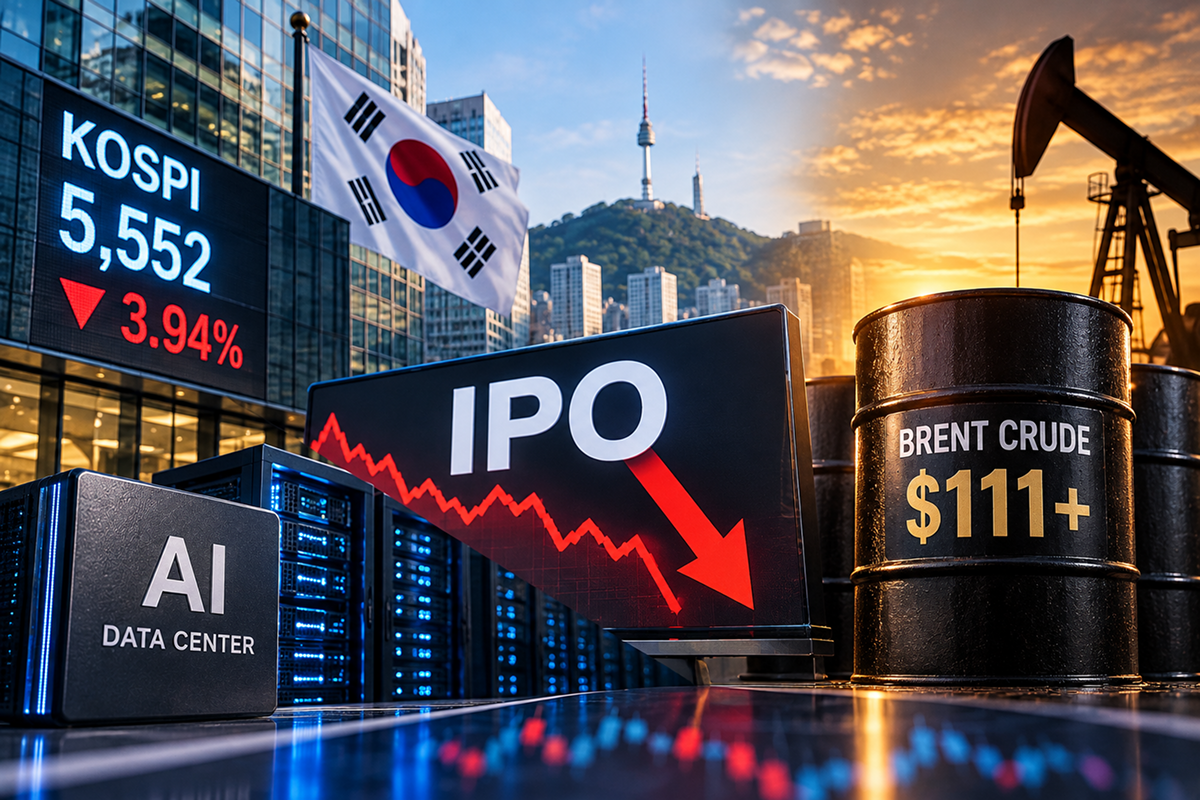
Elice (0158S0), a Seoul-based neocloud provider, closed at 60,500 won, equivalent to approximately $45.57, more than 30% below its initial public offering price of 90,500 won. According to Bloomberg, the IPO raised $151 million at a valuation of approximately $755 million. The decline followed an exceptionally strong retail subscription, with demand exceeding the available allocation by more than 400 times.
The contrast between heavy subscription demand and the subsequent share-price decline illustrates the difference between enthusiasm for an offering and the market’s willingness to sustain its valuation after trading begins. Although the debut does not establish the long-term prospects of Elice or the wider sector, it adds to questions about how investors are pricing companies positioned to benefit from AI infrastructure demand.
Debt and Capital Requirements Put Neocloud Economics Under Scrutiny
The pressure extends beyond South Korea. CoreWeave (CRWV) fell another 3% in U.S. premarket trading, while technology shares, Bitcoin and gold were also lower on Tuesday morning, according to CoinDesk. The report points to growing scrutiny of the neocloud sector, particularly borrowing costs, elevated debt levels and the profitability of capital-intensive expansion plans.
AI infrastructure providers must commit substantial capital to develop and expand computing capacity. The commercial case therefore depends not only on demand for AI services but also on whether future revenue and cash flow can justify financing costs and ongoing investment. If funding becomes more expensive or expected returns disappoint, highly leveraged businesses could face greater pressure to demonstrate financial discipline. Elice’s debut adds to the market’s reassessment of these risks, although one listing alone cannot determine the outlook for the entire AI sector.
South Korean Equities Fall as Oil Prices Add Market Uncertainty
Elice’s weak performance accompanied a broader decline in South Korean stocks. The KOSPI fell nearly 4% to close at 5,552, while Samsung Electronics declined approximately 3% and SK Hynix lost around 4%. The declines placed additional attention on technology and semiconductor-related exposure as investors evaluated the durability of the AI investment cycle.
At the same time, Brent crude rose above $111 per barrel, reaching its highest level since May, while West Texas Intermediate traded around $100. Brent’s premium of approximately $11 over WTI reflected persistent concerns about potential Middle Eastern supply disruptions and shipping risks.
Higher oil prices introduce a separate consideration for markets by increasing uncertainty around energy costs and the broader economic outlook. The CoinDesk report does not establish a direct causal link between crude prices and the AI-related sell-off; rather, both developments contributed to an unsettled trading environment. Their simultaneous occurrence nevertheless underscores how company-specific valuation concerns can coincide with wider geopolitical and macroeconomic pressures.
What Investors Will Be Watching Next
Attention will remain on whether AI infrastructure companies can demonstrate that their spending supports sustainable revenue, manageable debt and attractive operating economics. Further performance across technology and semiconductor shares may help indicate whether concerns are concentrated in individual companies or spreading more broadly through the sector. In energy markets, developments affecting Middle Eastern supply and shipping routes will remain important to the direction of crude prices. The interaction between financing costs, AI infrastructure returns and geopolitical risk is likely to remain central to market sentiment as investors reassess valuations and the durability of current investment commitments.
Comparison, examination, and analysis between investment houses
Leave your details, and an expert from our team will get back to you as soon as possible