Key Points:
- Solana has declined from its January 2025 all-time high of $294.85 to approximately $90, placing the token below the psychologically important $100 level.
- Its high transaction throughput, developer ecosystem and adoption by companies including Circle, Visa, PayPal and Stripe continue to support its long-term infrastructure proposition.
- Elevated interest rates, competition from Ethereum’s Layer 2 networks and uncertainty surrounding U.S. cryptocurrency regulation remain significant challenges for Solana’s future performance.
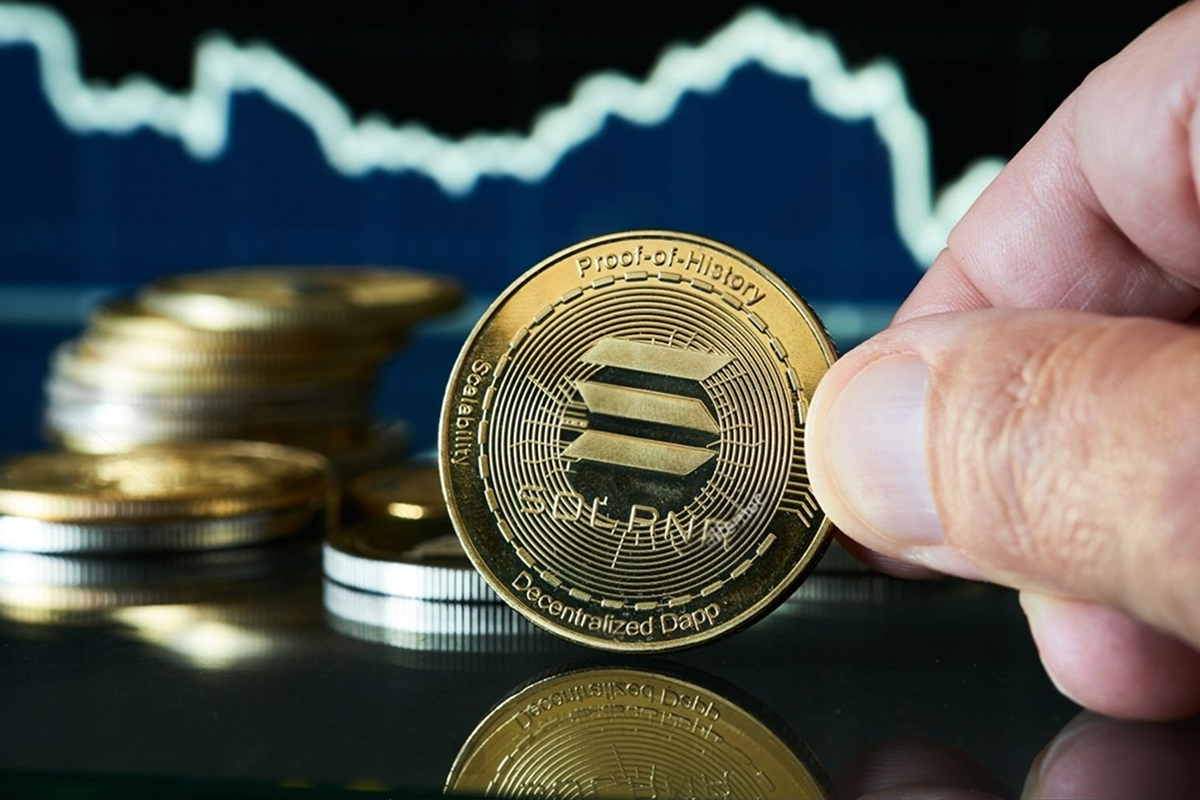
Solana’s decline below $100 has renewed questions about whether the cryptocurrency’s underlying technology and expanding institutional adoption can support a longer-term recovery. The token has fallen substantially from its January 2025 record of $294.85, trading at approximately $90 in the latest assessment by The Motley Fool. While the decline may attract attention from investors evaluating blockchain infrastructure, Solana’s prospects remain dependent on its ability to sustain ecosystem growth amid macroeconomic, competitive and regulatory pressures.
Transaction Speed and Developer Adoption Remain Solana’s Core Strengths
Solana operates as a proof-of-stake (PoS) blockchain, allowing holders to stake their tokens and participate in network security. Its infrastructure also supports smart contracts, which developers use to build decentralized applications and tokenize real-world assets.
One of Solana’s principal advantages is its transaction-processing architecture. Its proof-of-history mechanism timestamps transactions before validation, helping coordinate activity across the network. According to the figures cited by The Motley Fool, Solana’s Layer 1 blockchain processes approximately 1,000 to 3,700 transactions per second, compared with roughly 15 to 30 transactions per second for Ethereum’s Layer 1 network.
This performance has helped attract developers and establish Solana as the second-largest developer-oriented blockchain after Ethereum, according to the report. A growing developer base can support additional applications, network activity and demand for SOL, which is used to pay transaction fees.
Institutional Adoption Broadens Solana’s Commercial Potential
Solana’s ecosystem is increasingly relevant to established financial and payment companies. Circle, Visa, PayPal and Stripe have used its blockchain for activities including stablecoin transfers, real-world asset tokenization, cryptocurrency launches and transaction settlement.
These integrations demonstrate that blockchain adoption is not limited to speculative cryptocurrency trading. Payment providers and financial companies can use blockchain infrastructure to explore faster settlement processes and new forms of digital asset services.
For Solana, sustained institutional participation could create additional network activity and strengthen demand for its infrastructure. As more developers and businesses build applications on the network, SOL may benefit from its role in transaction payments and ecosystem participation. However, greater adoption of the blockchain does not automatically translate into proportional appreciation in the token’s market value.
The availability of spot-price Solana exchange-traded funds in the United States and Canada, launched in 2025 according to the report, also creates another potential channel for institutional exposure. Their longer-term significance will depend on investor demand and the broader regulatory environment.
Macroeconomic Conditions Continue to Challenge Crypto Valuations
Despite its technological strengths, Solana remains exposed to the same macroeconomic pressures affecting other digital assets. Elevated interest rates and Treasury yields can make traditional fixed-income investments more attractive relative to volatile cryptocurrencies. When the cost of capital remains high, investors may become more selective about allocating funds to assets whose valuations depend heavily on future adoption and growth expectations.
This environment can weigh on SOL even if its underlying network activity remains relatively resilient. Cryptocurrency valuations are influenced not only by technological development but also by liquidity conditions, investor risk appetite and expectations for monetary policy.
Ethereum Layer 2 Competition and U.S. Regulation Add Uncertainty
Solana must also maintain its competitive position against Ethereum’s expanding Layer 2 ecosystem. These networks process transactions outside Ethereum’s main blockchain before consolidating activity, offering higher throughput and potentially lower transaction costs. Cardano and Polkadot represent additional competitors in the broader market for developer-oriented blockchain infrastructure.
Regulatory uncertainty presents another challenge. The Motley Fool report argues that the Democratic takeover of both chambers of Congress following the U.S. midterm elections could complicate the continuation of the Trump administration’s crypto-friendly policies. It could also delay efforts to establish a clearer regulatory framework for digital assets.
The proposed CLARITY Act, intended to address regulatory questions surrounding the cryptocurrency market, had already encountered a failed Senate vote earlier in the year, according to the report. Further legislative uncertainty could affect institutional participation and the pace at which cryptocurrency businesses expand in the United States.
Solana’s Long-Term Case Depends on Execution and Market Conditions
Solana’s decline below $100 places its valuation under renewed scrutiny, but the lower price alone does not establish whether the token represents an attractive opportunity. Its transaction capacity, developer ecosystem and institutional integrations provide important foundations for continued adoption, while competition and macroeconomic conditions remain meaningful risks.
Going forward, investors will be watching network activity, developer growth, institutional integrations, ETF demand and progress toward regulatory clarity in the United States. Whether Solana can translate its technological advantages into sustained economic activity will be central to its longer-term outlook. The distinction between a lower market price and stronger underlying value remains particularly important as the cryptocurrency market navigates another period of uncertainty.
Comparison, examination, and analysis between investment houses
Leave your details, and an expert from our team will get back to you as soon as possible