Key Points:
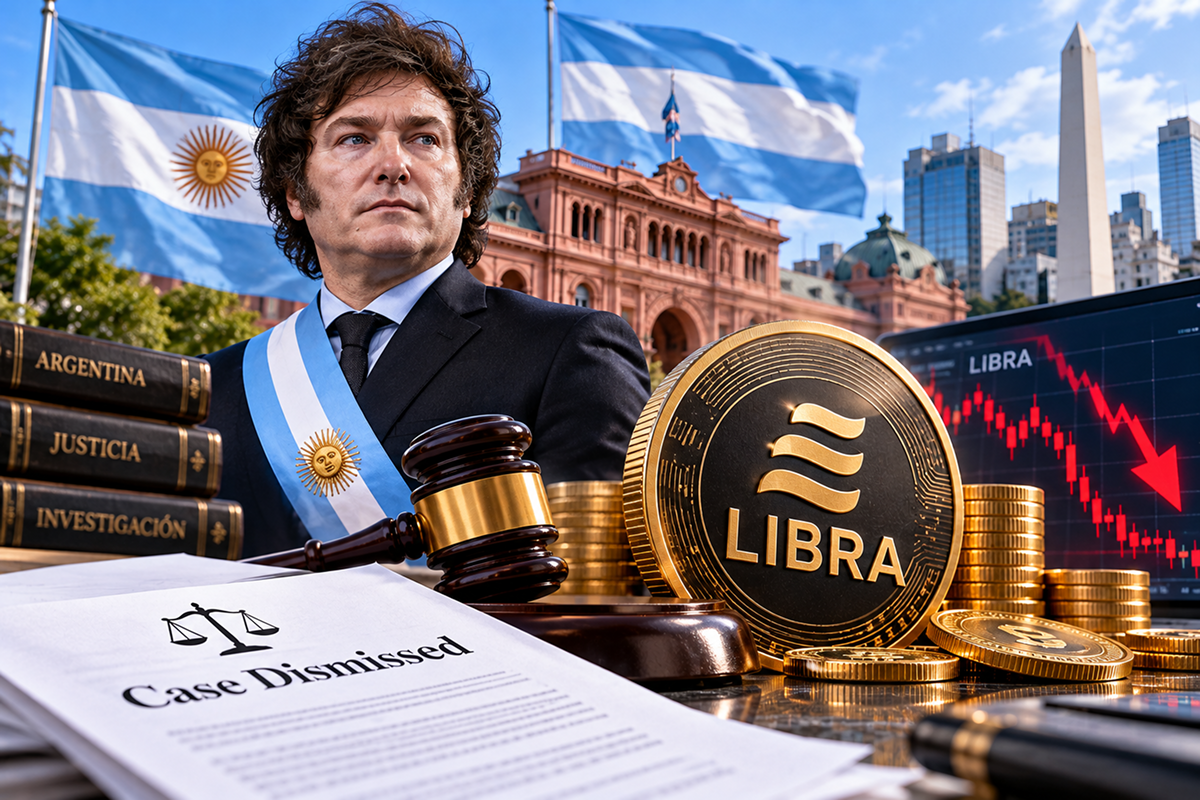
- An Argentine federal judge dismissed the criminal investigation into President Javier Milei, his sister Karina Milei, and U.S. businessman Hayden Davis over the LIBRA memecoin scandal.
- The judge found that Milei’s promotion of LIBRA did not, by itself, establish fraud, despite the token’s dramatic rally and subsequent collapse.
- Blockchain researchers reported that eight wallets linked to the token’s creator withdrew approximately $99 million, underscoring continuing questions about transparency and investor risk.
Argentina has dropped the criminal investigation into President Javier Milei’s involvement in the collapse of the LIBRA memecoin, closing a high-profile legal inquiry into a cryptocurrency promoted by the president on social media. The ruling marks a significant development at the intersection of politics and digital assets, but it does not eliminate broader concerns about token-launch transparency, concentrated ownership, and the influence of prominent public figures on speculative markets.
Judge Finds Insufficient Evidence of Fraud
Federal judge Marcelo Martínez de Giorgi dismissed the investigation on October 23, 2026, following a request from prosecutor Eduardo Taiano, according to court reporting. The inquiry had examined whether fraud occurred in connection with LIBRA’s launch and Milei’s public endorsement of the token in February 2025.
Milei had recommended LIBRA in a post on X, triggering a brief surge in attention and trading activity. He subsequently deleted the post, denied having a direct connection to the cryptocurrency, and said he had acted in good faith without understanding the project’s details.
The judge acknowledged that Milei’s position as president could have amplified the token’s launch. However, he determined that the influence associated with the presidency and the act of promoting the asset did not, on their own, establish a fraudulent scheme. The investigation into Milei’s sister, Karina Milei, and U.S. businessman Hayden Davis, who described himself as an adviser to LIBRA’s launch, was also dismissed.
The decision concerns the criminal case and its evidentiary threshold; it should not be interpreted as proof that every aspect of LIBRA’s launch or trading activity was beyond criticism.
The $99 Million Withdrawal Question
Despite the dismissal, the financial activity surrounding LIBRA remains central to understanding the controversy. Blockchain researchers reported that eight wallets linked to the token’s creator withdrew approximately $99 million worth of cryptocurrency from the project’s marketplace.
Davis also acknowledged holding close to $100 million after the token’s collapse, while denying wrongdoing. The reported wallet withdrawals and Davis’s holdings are separate details; available reporting does not establish that they represent the same funds or independently prove criminal conduct.
The scale of the reported activity illustrates a recurring vulnerability in speculative token markets: a rapid price increase can attract buyers before questions about ownership concentration, liquidity, and the distribution of tokens are fully understood. When substantial holdings are controlled by a small number of wallets, selling activity can intensify volatility and leave later participants exposed to steep losses.
Political Influence and Memecoin Market Risks
LIBRA’s rise and collapse also demonstrate how endorsements from influential figures can affect investor behavior. Public attention can generate rapid demand, particularly in memecoins whose valuations often depend heavily on online narratives, community momentum, and speculative expectations rather than established cash flows.
For crypto investors, the episode reinforces the importance of distinguishing publicity from independent verification. A prominent endorsement does not establish a project’s financial soundness, disclose insider holdings, or guarantee that sufficient liquidity will remain available when market sentiment reverses.
The case also highlights the limits of criminal proceedings as a measure of market quality. A decision that evidence does not establish fraud under criminal law does not remove the need for transparent token distribution, credible disclosures, and effective safeguards for participants.
What Investors Should Watch Next
The dismissal closes a major chapter in the criminal investigation, but its broader implications will depend on whether further legal challenges emerge and whether the controversy prompts stronger scrutiny of politically promoted digital assets. For the crypto industry, the lasting issue is trust: markets need clearer information about token creators, concentrated holdings, liquidity, and the risks attached to promotional campaigns. LIBRA’s case demonstrates that celebrity or political visibility can accelerate a token’s rise, but cannot substitute for transparency and sound market infrastructure.
Comparison, examination, and analysis between investment houses
Leave your details, and an expert from our team will get back to you as soon as possible