

Key Points:
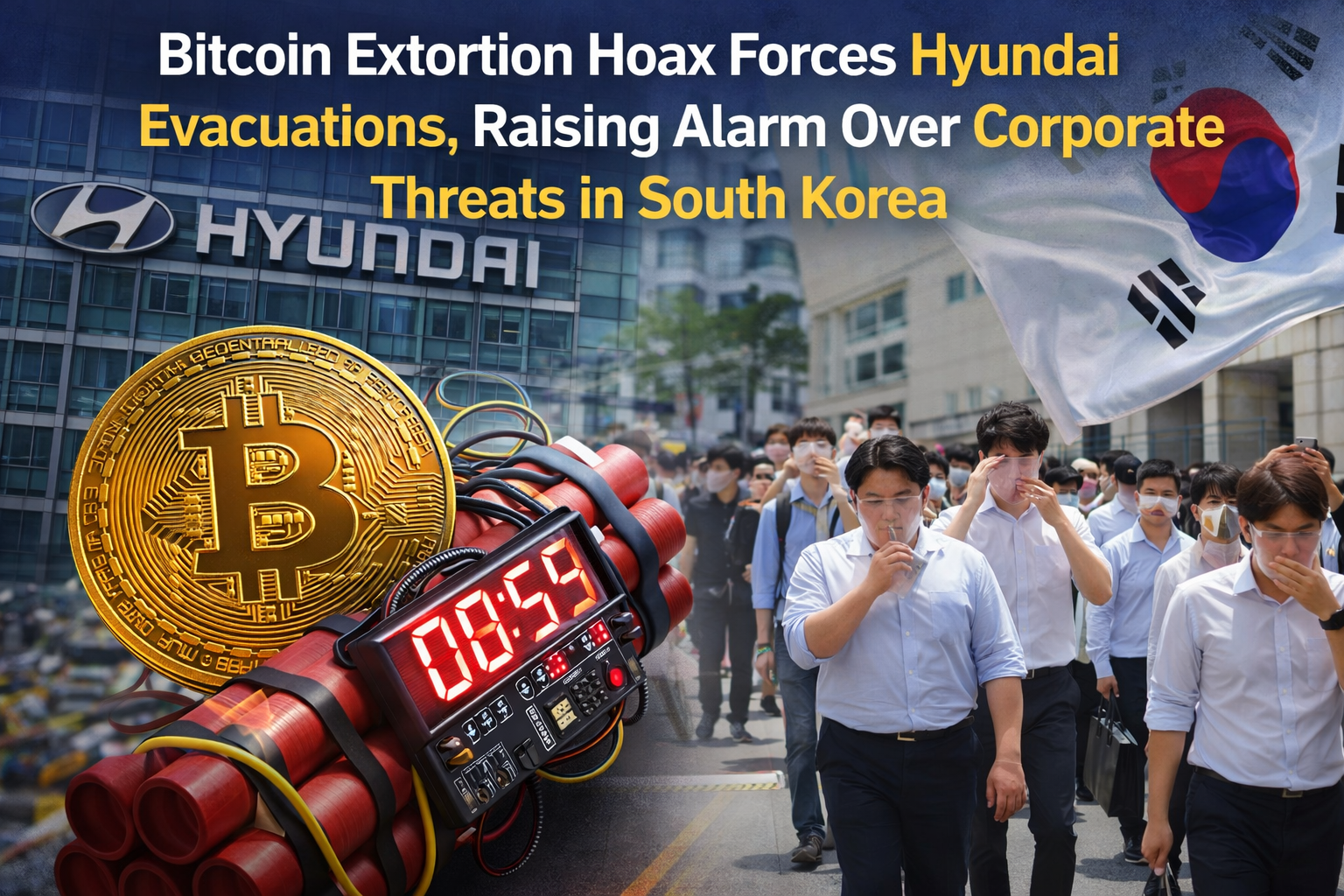
Hyundai Group evacuated two major Seoul offices after receiving a bomb threat demanding payment in bitcoin.
Authorities later confirmed the threat was a hoax, but the incident follows a string of similar extortion attempts targeting major Korean firms.
The episode underscores growing concerns around digital extortion tactics that exploit cryptocurrency’s anonymity rather than actual security risks.
Hyundai Group was forced to evacuate employees from two prominent office locations in Seoul on Friday after receiving an email threatening to detonate explosives unless the company paid a ransom in bitcoin, according to South Korean police. Although authorities later determined the threat was a hoax, the incident heightened concerns over a recent surge in digital extortion attempts aimed at some of the country’s largest corporations.
Police said an emergency call was received at approximately 11:42 a.m. local time, reporting the contents of an email sent to Hyundai Group. The message claimed that an explosive device had been planted at Hyundai’s Yeonji-dong office in Jongno District, with a second bomb allegedly destined for the company’s Yangjae-dong complex in Seocho District, a major hub for Hyundai Motor Group operations.
The sender demanded payment of 13 bitcoin, an amount worth roughly $1.1 million, or about 16.4 billion won at current prices. The email warned that failure to comply would result in explosions at both locations.
Swift Evacuations and Security Response
In response, Hyundai immediately evacuated staff from both offices as a precaution. Police deployed bomb disposal units, special response teams, and emergency personnel to conduct full sweeps of the buildings and surrounding areas. Access to nearby streets was temporarily restricted as authorities searched for any sign of explosive devices.
After several hours of inspection, police concluded that no bombs were present and classified the threat as a hoax. Employees were gradually allowed to return, and normal operations resumed later in the day. No injuries were reported, and no ransom was paid.
While the immediate danger proved unfounded, officials said the incident was treated with full seriousness due to the specificity of the threat and the scale of potential harm.
Part of a Broader Pattern
The Hyundai scare follows a series of similar threats targeting major South Korean corporations over the past week. Earlier incidents involved bomb threats posted online against Samsung Electronics, Kakao, Naver, and telecommunications provider KT, prompting evacuations and emergency searches at multiple corporate facilities.
In each case, authorities found no explosives. Investigators believe the threats are part of a coordinated or copycat pattern of digital extortion attempts designed to exploit fear, disrupt operations, and pressure companies into paying ransoms.
Unlike traditional cybercrime focused on hacking or data theft, these cases rely on psychological pressure and the logistical burden imposed by emergency responses, which can cost companies millions in lost productivity even when no physical risk exists.
Why Bitcoin Is Being Used
Law enforcement officials and cybersecurity experts note that bitcoin’s use in these threats reflects its perceived anonymity rather than any inherent link to corporate crime. While blockchain transactions are traceable, extortionists often believe cryptocurrency provides a layer of protection from identification, particularly when combined with anonymous email services or offshore infrastructure.
South Korea has relatively strong crypto regulation and exchange oversight, making successful ransom collection increasingly difficult. As a result, authorities suspect the perpetrators may be operating from abroad or seeking disruption rather than actual payment.
What Comes Next
Police said investigations are ongoing to trace the origin of the messages and identify those responsible. Officials are also reviewing whether additional safeguards or protocols are needed to handle the rising volume of hoax threats without causing unnecessary disruption.
For South Korea’s corporate sector, the incidents serve as a reminder that digital extortion does not always target data or finances directly. As threat vectors evolve, companies may need to balance rapid response with improved threat verification to reduce operational impact while maintaining public safety.













https://shorturl.fm/kGMpI
https://shorturl.fm/SZdQ9
https://shorturl.fm/9FgPY
https://shorturl.fm/9FgPY