Key Points:
- California’s public pension fund, CalPERS, reduced its direct shareholdings in the Magnificent Seven technology companies by 26% during the first half of 2026, according to the Financial Times.
- The fund, which manages more than $600 billion, is increasing its private equity exposure as it reassesses valuations in public markets and reduces dependence on a small group of technology leaders.
- AI infrastructure providers, including CoreWeave, Cipher Digital and IREN, faced renewed selling pressure amid concerns about financing availability and the returns on heavy data-center investment.
California Public Employees’ Retirement System (CalPERS), one of the world’s largest public pension funds, is reducing its exposure to major U.S. technology stocks as investor concerns grow over artificial intelligence valuations and the sustainability of AI infrastructure spending. The portfolio shift comes as financing pressures spread to specialized cloud providers, raising questions about whether the revenue generated by AI services can justify the capital required to build and operate data centers. For crypto investors, the development offers another indication of changing risk appetite across technology-linked assets and the broader digital economy.
CalPERS Reduces Concentration in Mega-Cap Technology
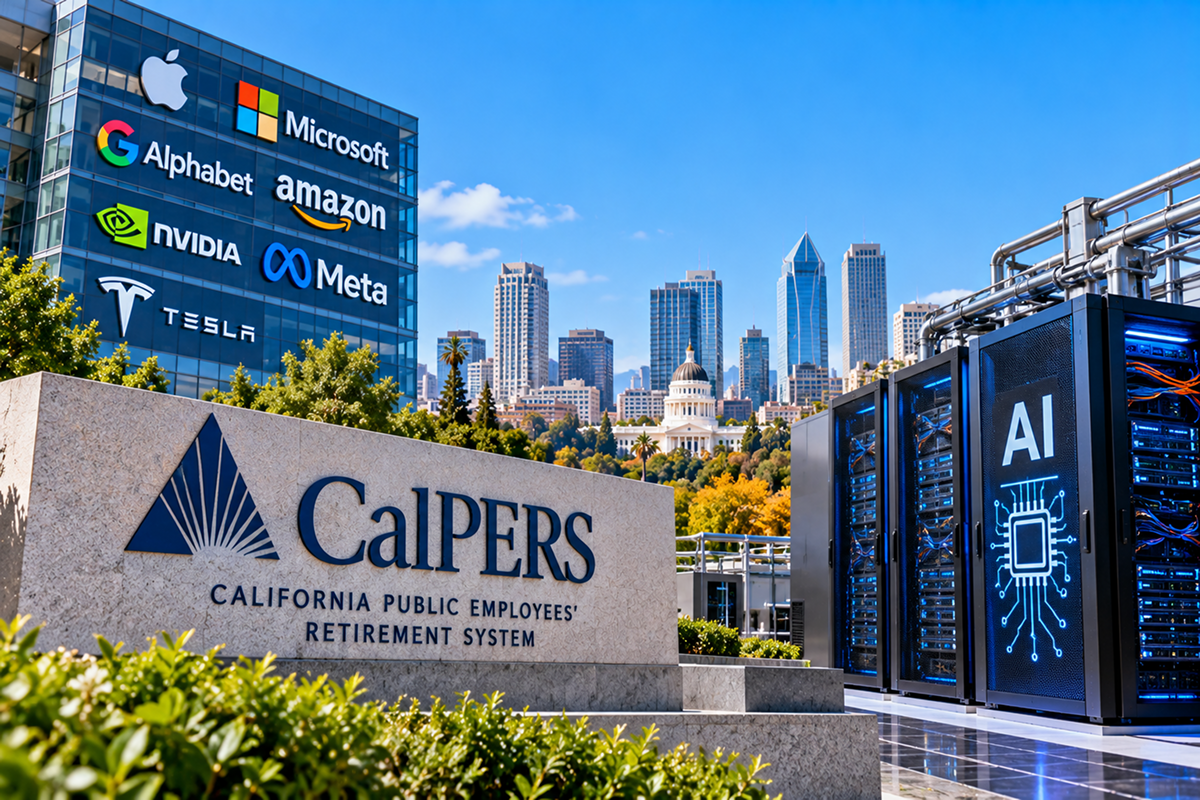
CalPERS reduced the combined number of shares it directly held in the Magnificent Seven by 26% during the first half of 2026, according to Financial Times calculations based on regulatory filings cited by CoinDesk. The group includes Apple, Microsoft, Alphabet, Amazon, Nvidia, Meta Platforms and Tesla.
The fund manages more than $600 billion and is increasing its allocation to private equity as part of an effort to diversify across a wider range of businesses. Deputy Chief Investment Officer Anton Orlich told the Financial Times that public equity valuations appeared expensive and that major technology companies could underperform other investments.
The shift does not necessarily represent a wholesale rejection of AI or technology. Instead, it reflects an institutional portfolio decision to reassess concentration risk and the relative attractiveness of different asset classes. For large pension funds, even modest allocation changes can involve substantial capital and may signal a more cautious approach to valuations that have benefited from expectations of continued AI growth.
AI Infrastructure Faces Questions Over Funding and Returns
The repricing extends beyond established technology companies to the specialized providers supplying computing capacity for AI workloads. CoreWeave, Cipher Digital and IREN came under selling pressure in premarket trading on October 26, according to CoinDesk, as concerns intensified about the financing available to companies heavily exposed to AI data centers.
Elon Musk warned that financing had largely dried up for companies without substantial revenue beyond AI data-center operations. His comments highlighted a potential vulnerability in the sector: infrastructure providers often need significant upfront capital to acquire computing equipment and build facilities, while their returns depend on sustained customer demand and sufficient utilization.
CoinDesk also reported that SpaceX had raised $40 billion in debt to purchase graphics processing units for AI computing. The transaction underscores the scale of capital involved in the infrastructure race, although one company’s financing arrangements should not be taken as proof that every AI provider faces identical constraints.
Market Performance Signals a More Selective Investment Climate
Performance across large technology companies has become increasingly uneven. The Roundhill Magnificent Seven ETF was up approximately 7% year to date at the time of the report, supported by a 34% gain in Apple and a 12% rise in Nvidia. Meta, Alphabet and Tesla, however, were down for the year, demonstrating that the group no longer moved uniformly.
This divergence matters because investors are increasingly distinguishing between companies with established earnings and those whose valuations depend on future AI spending. As financing costs, capital expenditure and revenue visibility receive closer scrutiny, businesses with uncertain paths to profitability may face greater pressure.
For crypto markets, the implications are indirect but relevant. Digital assets can be affected by changes in liquidity and appetite for high-volatility investments, even when the underlying businesses differ substantially from technology companies. A sustained reduction in risk-taking across growth assets could weigh on crypto sentiment, although the performance of Bitcoin and other digital assets will also depend on their own market structure, flows and macroeconomic drivers.
Investors will be watching whether CalPERS continues reducing concentrated public-equity exposure, whether AI infrastructure companies can demonstrate sustainable cash flows, and how lenders assess financing for data-center expansion. The key issue is not simply whether AI demand continues to grow, but whether the returns generated by that demand justify the capital being deployed. Until greater clarity emerges, valuation discipline and funding access are likely to remain central themes across technology markets, with potential spillover effects for crypto-related risk appetite.
Comparison, examination, and analysis between investment houses
Leave your details, and an expert from our team will get back to you as soon as possible