

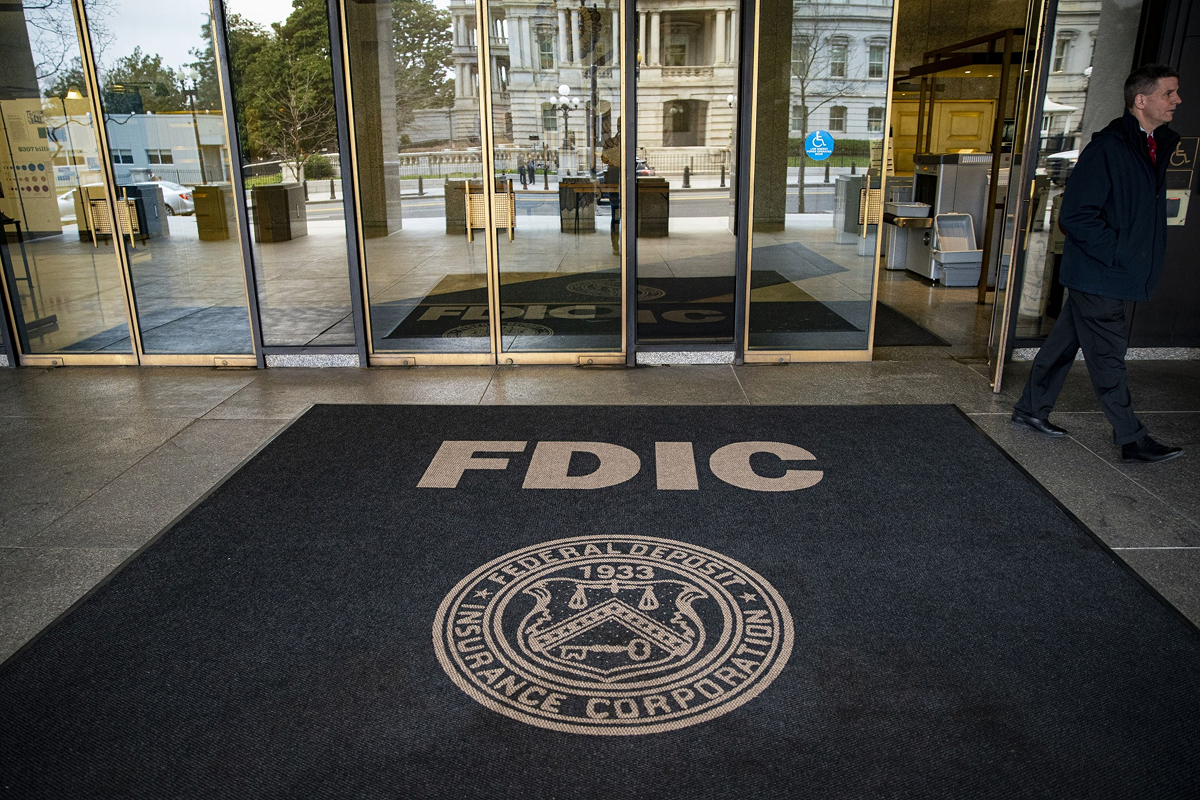
The U.S. Federal Deposit Insurance Corporation has proposed the first domestic stablecoin rule to emerge from the GENIUS Act, offering long-awaited clarity on how dollar-pegged tokens may operate within the U.S. banking system. The proposal lands as stablecoins process trillions in annual transaction volume and as policymakers seek to balance innovation with financial stability.
Market Context and Immediate Signals
Stablecoins now underpin the majority of crypto trading and on-chain settlement. Aggregate monthly volumes routinely exceed $1 trillion, with U.S. dollar-pegged tokens accounting for more than 90% of activity. USDT and USDC together represent roughly $160 billion in circulating supply, making regulatory clarity material for liquidity, market structure, and counterparty risk.
Crypto prices showed muted reaction following the FDIC proposal, suggesting markets had partially priced in a framework-oriented outcome. Bitcoin traded near $82,000 and ether around $4,400, while stablecoin market caps remained largely unchanged—an indication that participants view the rule as evolutionary rather than disruptive.
Regulatory Scope and Technical Requirements
The proposed rule outlines requirements for reserve composition, disclosure, and issuer oversight for stablecoins that interface with insured depository institutions. Under the framework, qualifying issuers would be expected to maintain high-quality liquid reserves—primarily cash and short-dated U.S. Treasurys—and submit to regular audits and reporting.
Importantly, the FDIC signals a pathway for banks to participate in stablecoin issuance and custody, provided risk management standards are met. This could accelerate bank-led pilots and partnerships, particularly for settlement and payments use cases. Industry estimates suggest bank-integrated stablecoins could reduce cross-border settlement costs by 40%–60% compared with traditional correspondent banking.
Investor Sentiment and Strategic Implications
For institutional investors, the proposal reduces regulatory uncertainty that has constrained allocations and product development. Asset managers and payment firms are likely to interpret the rule as a green light to expand U.S.-based offerings, especially as Europe’s MiCA regime and Asian frameworks gain traction.
Behaviorally, clearer rules tend to compress risk premia. As compliance pathways solidify, investors may increasingly differentiate between regulated and unregulated stablecoins, potentially reshaping market share over time. Issuers with transparent reserves and banking ties could benefit, while opaque models may face higher funding and adoption hurdles.
Looking ahead, the proposal enters a public comment period, with finalization expected to hinge on coordination among the FDIC, Federal Reserve, and Treasury. Key watch points include how reserve requirements are calibrated, whether yield-bearing features are permitted, and how interoperability with tokenized deposits evolves. While compliance costs may rise, the framework positions stablecoins as a durable component of U.S. financial infrastructure—an outcome with broad implications for payments, trading, and on-chain finance.












https://shorturl.fm/YnVpv
https://shorturl.fm/pXdQO