Key Takeaways
- Kalshi has filed a lawsuit against Illinois officials, escalating the legal battle over the regulation of prediction markets in the United States.
- The case could influence how event-based contracts are regulated and whether federal oversight takes precedence over state restrictions.
- Crypto investors are closely monitoring the dispute as prediction markets increasingly intersect with digital asset trading and decentralized finance.
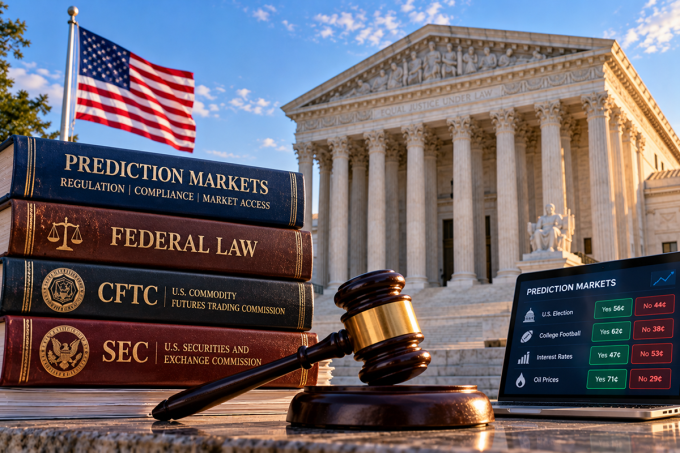
Prediction market operator Kalshi has launched a legal challenge against Illinois regulators, arguing that state-level restrictions conflict with federal authority governing regulated event contracts. The dispute arrives at a pivotal moment for alternative financial markets, as prediction platforms gain popularity among retail and institutional participants seeking exposure to political, economic, and real-world outcomes.
Beyond the immediate legal questions, the case highlights broader tensions between state regulators and federally supervised financial venues. For crypto investors, the outcome could shape how emerging market structures are governed and integrated into the wider digital asset ecosystem.
Legal Battle Highlights Jurisdictional Tensions
At the center of the lawsuit is the question of whether federally regulated prediction market operators can offer event-based contracts without interference from individual states. Kalshi operates under oversight from the Commodity Futures Trading Commission (CFTC), which has increasingly become a focal point in discussions surrounding innovative financial products.
The prediction market industry has experienced significant growth over the past two years, with trading activity on major platforms expanding as users seek ways to express views on elections, economic indicators, and geopolitical developments. The increasing volume has drawn attention from both regulators and investors concerned about market integrity and consumer protections.
The Illinois case may establish an important precedent regarding the balance of power between federal and state authorities in overseeing emerging financial products.
Implications for Crypto and Digital Asset Markets
While the lawsuit is not directly related to cryptocurrency trading, the implications extend into digital asset markets. Prediction markets share several characteristics with crypto platforms, including online accessibility, real-time pricing mechanisms, and participation from globally connected investors.
Many blockchain-based projects have explored decentralized prediction markets as a potential growth sector. Regulatory clarity surrounding traditional prediction markets could influence how authorities approach similar products operating on decentralized networks.
Investors are particularly interested in whether courts reinforce federal oversight frameworks, as consistent regulation may reduce uncertainty for companies developing innovative financial infrastructure.
Investor Sentiment and Market Evolution
The legal challenge arrives during a period when investors are placing greater emphasis on regulatory certainty. Since 2022, regulatory developments have frequently influenced capital flows across both traditional and digital asset markets.
Institutional participants generally favor predictable legal frameworks because they reduce operational and compliance risks. The Kalshi case is being viewed by many market observers as part of a broader trend in which courts increasingly play a role in defining the boundaries of financial innovation.
From a behavioral perspective, investors often interpret regulatory disputes as signals about future market accessibility. Favorable outcomes can encourage participation, while uncertainty may delay capital deployment until legal questions are resolved.
What the Industry Will Be Watching Next
The lawsuit between Kalshi and Illinois regulators has implications that extend beyond a single platform. It touches on fundamental questions about jurisdiction, financial innovation, and the future structure of event-based markets in the United States.
For crypto investors and institutions, the case serves as another reminder that regulatory developments remain a key market driver. As prediction markets continue to grow and intersect with digital finance, the outcome could influence how future products are launched, regulated, and adopted. The legal proceedings may ultimately help define the operating environment for a new generation of market platforms seeking to bridge traditional finance and emerging technologies.
Comparison, examination, and analysis between investment houses
Leave your details, and an expert from our team will get back to you as soon as possible