Key Points:
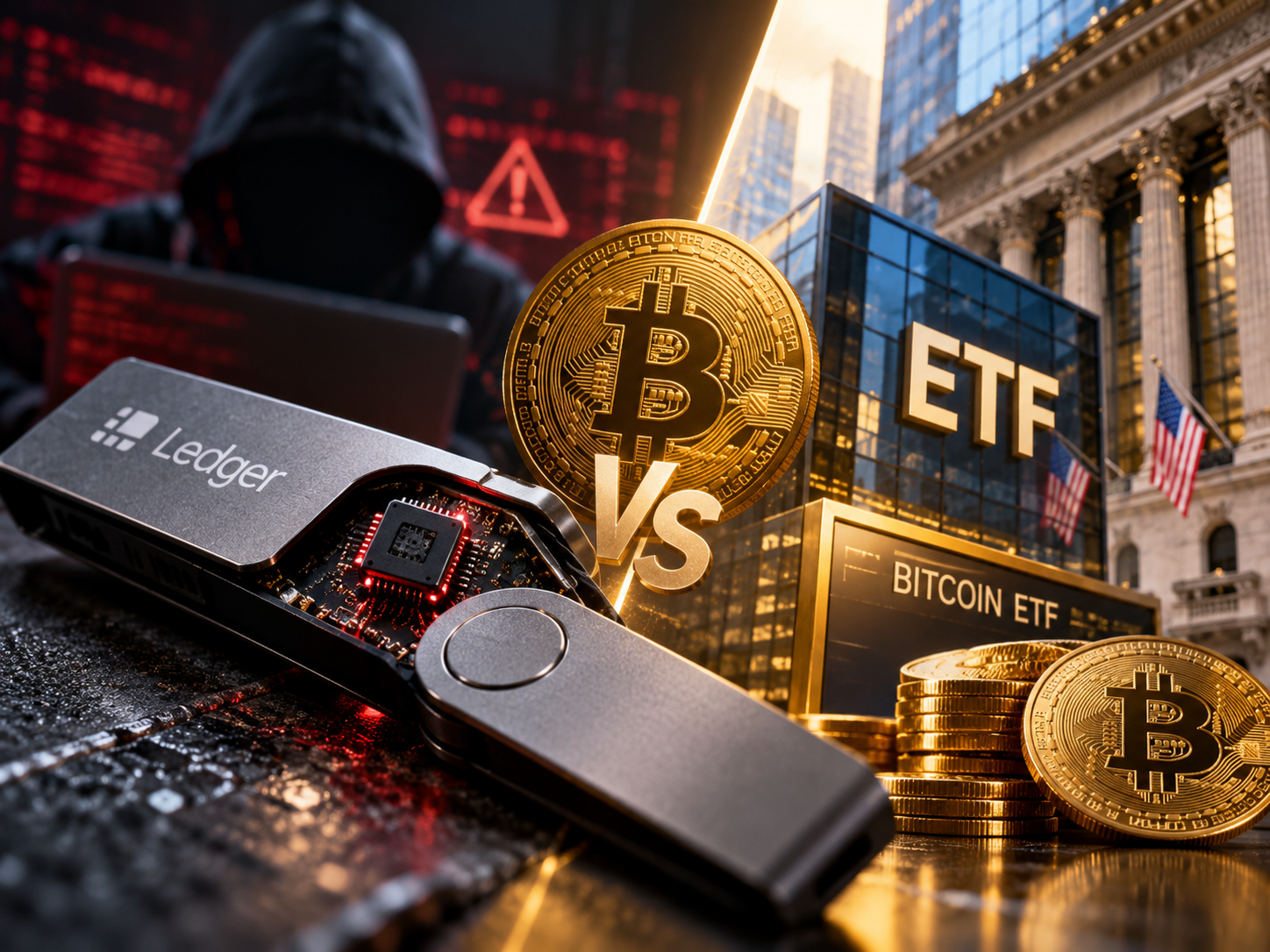
- The discovery of an unauthorized hardware implant in a Ledger wallet has renewed debate over whether Bitcoin exchange-traded funds (ETFs) offer a safer alternative to hardware-based self-custody.
- Industry figures remain divided on the trade-offs, with some highlighting the security expertise of professional custodians and others warning against rushed changes to self-custody arrangements.
- Blockstream CEO Adam Back called for stronger threat modeling among hardware wallet manufacturers, while security researcher Jameson Lopp cautioned against creating new vulnerabilities through mass migrations.
Ledger Incident Reopens Bitcoin Custody Debate
The discovery of an unauthorized hardware implant in a Ledger device has renewed scrutiny of Bitcoin custody practices, prompting investors to reconsider the trade-offs between controlling private keys directly and holding exposure through regulated financial products.
Bitcoin analyst Plan B said the incident reinforced his decision to move his Bitcoin holdings into exchange-traded funds in 2025. In a Monday post on X, he described the decision as one he had “zero regrets” about, citing recent hardware wallet security incidents involving Ledger and Coldcard.
The debate highlights two different approaches to protecting Bitcoin holdings. Self-custody gives investors direct control over their private keys, while ETFs allow investors to obtain exposure to Bitcoin without personally managing the underlying keys.
Neither approach eliminates risk. Hardware wallets can be affected by device-level compromises, setup errors and other security weaknesses, while ETF investors depend on fund structures, custodians and financial intermediaries.
Institutional Custody Gains Attention
Ophelia Snyder, co-founder of investment product provider 21Shares, said large cryptocurrency holders have been moving self-custodied assets into ETFs for years, with enhanced security among the main reasons.
According to Snyder, the recent hardware wallet incidents have brought this practice into wider public discussion. Professional custody providers can offer specialized security procedures and operational controls that individual investors may find difficult to implement independently.
However, the relative security of each option depends on the investor’s circumstances, the provider’s safeguards and the specific risks involved. ETF investors exchange direct control of private keys for reliance on a financial product and its custody arrangements.
The Ledger incident has intensified this comparison after the discovery of a device containing an unauthorized hardware implant. Blockchain investigators estimated that related losses could exceed $86 million, although the reported figure does not establish the full extent of the damage or the number of affected devices.
Adam Back Calls for Stronger Hardware Wallet Security
Despite the renewed concerns, Blockstream CEO and Hashcash inventor Adam Back maintained that hardware wallets can remain secure tools for cryptocurrency self-custody.
Back argued that manufacturers need to improve their understanding of potential attacks and strengthen their threat-modeling practices. In a Saturday post on X, he criticized what he described as gaps in manufacturers’ understanding of generic attack methods, pointing to the need for stronger security analysis across the industry.
Threat modeling helps manufacturers identify how devices might be compromised, evaluate potential attack paths and design safeguards before vulnerabilities are exploited. The Ledger incident has placed renewed emphasis on the possibility that security risks can extend beyond software and conventional private-key management.
For hardware wallet providers, the challenge is to account for threats involving device integrity, manufacturing and distribution, as well as the processes used to initialize and secure wallets.
Self-Custody Requires Careful Setup
Snyder argued that self-custody security depends heavily on an investor’s technical knowledge and the rigor applied during setup. She said investors who do not configure their wallets properly may be less protected than those relying on specialist firms with dedicated security expertise.
Bitcoin security researcher Jameson Lopp also emphasized the importance of caution. While recognizing self-custodial wallets as a potentially robust option, he warned against mass migrations that could introduce new vulnerabilities.
Moving Bitcoin to new addresses can create additional risks if investors act hastily, make transaction errors or establish new points of failure while trying to respond to a perceived threat. Security decisions therefore require careful assessment rather than automatically assuming that changing devices or addresses will improve protection.
The broader issue is not simply whether self-custody or ETFs are safer in every situation, but how each method distributes responsibility, operational complexity and exposure to different types of risk.
Outlook
The Ledger hardware implant discovery has sharpened the debate over Bitcoin custody as investors weigh direct control against professionally managed alternatives. ETFs may appeal to holders seeking specialized custody arrangements, while hardware wallets remain an option for those prepared to manage private keys and security procedures themselves.
The longer-term implications will depend on how hardware wallet manufacturers strengthen their defenses, how custody providers maintain their safeguards and how investors respond to emerging threats. Rather than establishing a universal winner, the incident underscores the importance of understanding the distinct risks associated with each custody model before making changes to Bitcoin holdings.
Comparison, examination, and analysis between investment houses
Leave your details, and an expert from our team will get back to you as soon as possible