Key Points:
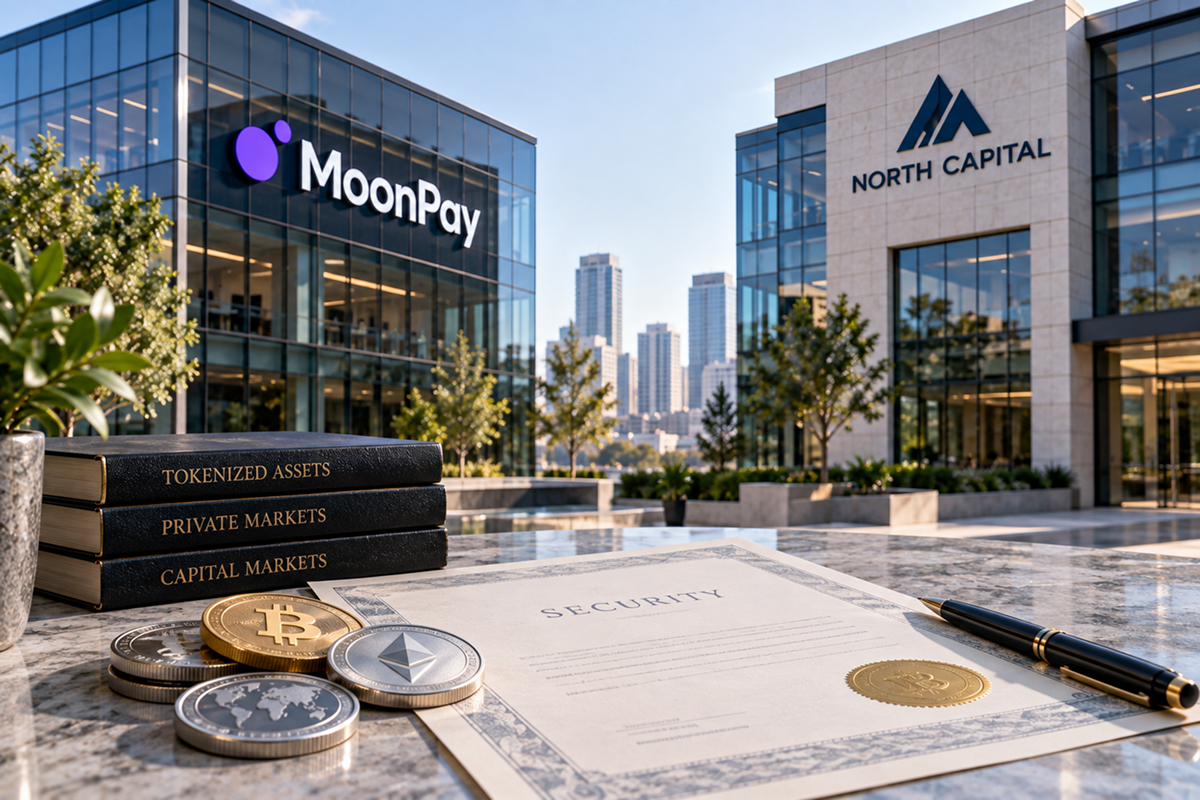
- MoonPay plans to acquire North Capital in an all-stock transaction valued at more than $60 million, subject to regulatory approval and customary closing conditions.
- North Capital has facilitated approximately $9 billion in primary and secondary transaction volume and brings broker-dealer, trading, transfer-agent and investment-advisory infrastructure.
- The acquisition would accelerate MoonPay’s shift from crypto payments toward tokenized real-world assets and onchain capital markets, an area receiving greater attention from traditional financial institutions.
MoonPay is moving deeper into regulated financial infrastructure with an agreement to acquire North Capital Investment Technology in an all-stock deal valued at more than $60 million. The transaction comes as tokenized securities move closer to mainstream financial markets, following recent U.S. regulatory steps aimed at creating a framework for blockchain-based representations of traditional assets.
North Capital Adds Regulated Market Infrastructure
North Capital, based in Salt Lake City, has processed approximately $9 billion in primary and secondary transaction volume through its private-markets platform. Its technology supports capital raising, asset management, clearing, custody and secondary trading for private securities, including tokenized assets.
The company’s affiliates also hold U.S. regulatory registrations covering broker-dealer, alternative trading system, transfer-agent and investment-advisory activities. Following completion, North Capital is expected to operate as a wholly owned subsidiary of MoonPay. The transaction remains subject to regulatory approval, making the regulatory process an important part of the deal’s execution timeline.
MoonPay Broadens Beyond Crypto Payments
The acquisition represents a significant expansion of MoonPay’s business model. The company has historically focused on infrastructure connecting users and businesses with cryptocurrency, but it has increasingly moved toward broader financial-market services.
MoonPay recently established its Trade platform, designed to connect banks and fintech companies with tokenized assets, decentralized-finance protocols and stablecoin liquidity. The North Capital acquisition adds regulated securities-market capabilities to that infrastructure, potentially allowing MoonPay to participate more directly across the issuance, custody and secondary-market lifecycle of tokenized private assets.
The company has also pursued acquisitions in other areas of digital-asset infrastructure, including Solana-based trading infrastructure provider DFlow and security company Sodot. The pattern indicates a strategy centered on assembling multiple layers of institutional and onchain financial infrastructure rather than remaining focused solely on retail crypto payments.
Tokenization Moves Closer to Traditional Markets
The timing is significant because U.S. regulators have recently taken steps toward integrating tokenized securities into established financial-market structures. On September 17, the Securities and Exchange Commission introduced a five-year innovation exemption covering certain platforms and liquidity providers involved in tokenized stock trading.
The framework requires tokenized securities covered by the exemption to preserve equivalent shareholder rights, including voting and dividend rights, while excluding synthetic tokens that merely track stock prices without representing ownership. Issuers can also object to the listing of tokenized versions of their securities.
Institutional Tokenization Becomes the Next Test
For crypto investors, the transaction illustrates how the industry’s competitive landscape is expanding beyond exchanges, stablecoins and conventional digital assets. Tokenized equities, private securities and funds could create new demand for blockchain settlement infrastructure, but the commercial opportunity depends on regulatory clarity, issuer participation, liquidity and institutional adoption.
MoonPay’s challenge will be integrating North Capital’s regulated operations with its existing digital-asset infrastructure without creating compliance or operational friction. Investors will therefore be watching the regulatory approval process, MoonPay’s subsequent product launches and the volume of tokenized securities moving through the combined platform. If those metrics develop meaningfully, the acquisition could provide a clearer indication of how crypto-native companies are positioning themselves for the convergence of blockchain infrastructure and traditional capital markets.
Comparison, examination, and analysis between investment houses
Leave your details, and an expert from our team will get back to you as soon as possible