Key Points:
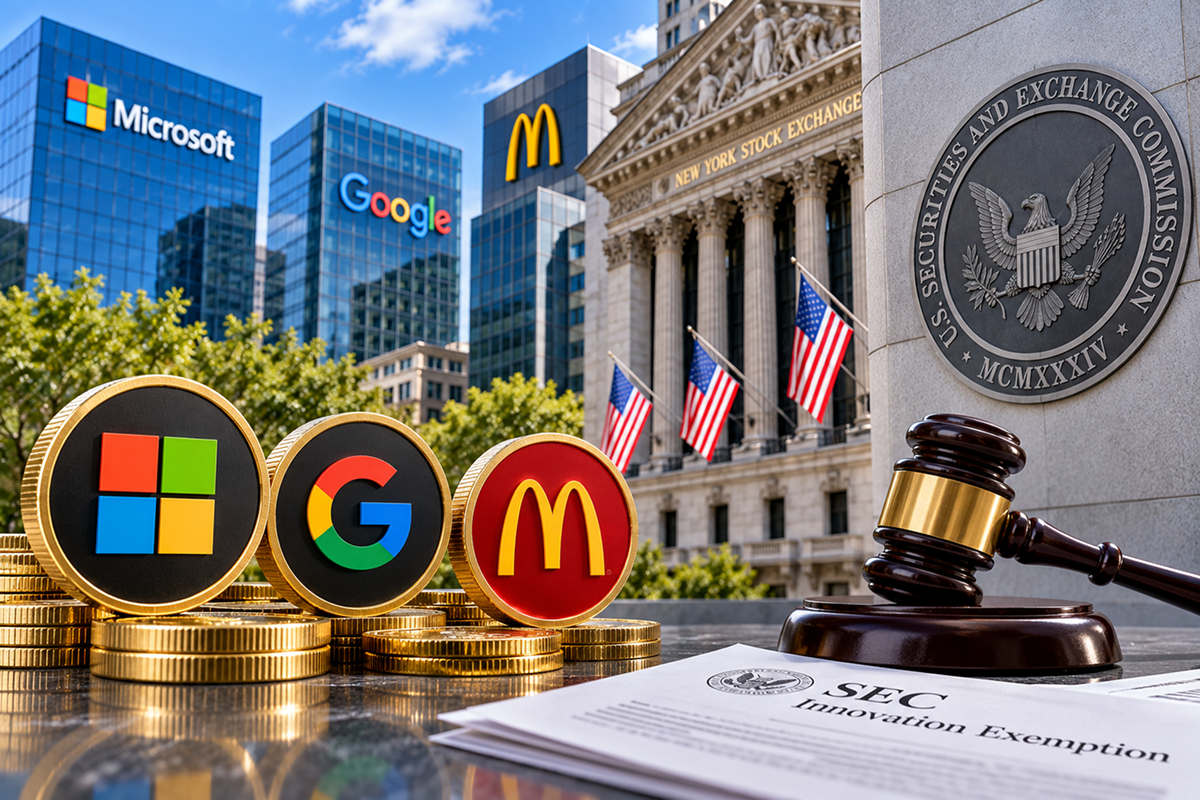
- Microsoft, Alphabet (Google), and McDonald’s are among major companies objecting to having their shares listed on a proposed tokenized-stock venue backed by OKX and Intercontinental Exchange (ICE).
- The SEC’s Innovation Exemption allows qualifying venues to explore tokenized stock trading under temporary conditions, while giving issuers the right to object to third-party tokenized listings.
- Despite issuer resistance, tokenization could still advance through issuer-approved securities, other participating companies, and blockchain-based financial infrastructure.
The decision by major corporations including Microsoft, Alphabet, and McDonald’s to oppose the tokenization of their shares has introduced a significant challenge for one of blockchain finance’s most closely watched developments. Yet the objections do not necessarily signal a rejection of tokenization itself; instead, they highlight the importance of issuer consent, shareholder protections, and regulatory certainty as traditional financial markets explore blockchain-based trading.
Issuer Resistance Creates an Early Hurdle
According to reporting by CoinDesk and Reuters, major companies have objected to plans by OKXICE, a joint venture involving cryptocurrency exchange OKX and Intercontinental Exchange, the parent company of the New York Stock Exchange, to offer tokenized versions of publicly traded stocks. The proposed venue initially identified 63 stock tickers representing 62 companies, including prominent technology and consumer businesses.
By October 23, regulatory disclosures and reporting indicated that 22 companies had objected to having their shares tokenized through the initiative. The disclosures did not specify each company’s reasons, making it inappropriate to assume that every objection reflects opposition to blockchain technology itself.
For issuers, the issue may involve control over how their shares are represented, distributed, and traded. Companies may also want clarity on investor rights, market surveillance, liquidity, and the potential effects of trading outside established stock-market infrastructure. These concerns can slow a particular platform without invalidating the broader technological concept.
The SEC Framework Defines What Can Proceed
On September 17, the U.S. Securities and Exchange Commission (SEC) introduced its Innovation Exemption, providing temporary, conditional relief for qualifying Tokenized Securities Venues. The framework is intended to facilitate experimentation with on-chain trading of certain U.S.-listed stocks while regulators consider longer-term rules.
Crucially, the exemption does not allow platforms to disregard corporate objections. For qualifying third-party tokenized stocks, venues must notify the issuer and provide an opportunity to object. If the issuer formally objects within the applicable process, the venue cannot list that tokenized security under the exemption.
The order also requires tokenized shares to preserve the rights and privileges of equivalent traditional shares, including dividend and voting rights. The relief is temporary and subject to conditions, with the exemptions scheduled to expire five years after publication of the order. These requirements underscore that tokenization must address securities-law obligations rather than simply place stock-related tokens on a blockchain.
Why Tokenization Can Still Move Forward
Resistance to one venue does not prevent other companies from exploring tokenization through different structures. Issuers may choose to authorize tokenized securities themselves, while financial institutions can continue developing blockchain infrastructure for issuance, settlement, custody, and asset servicing.
The potential advantages remain relevant: extended trading access, faster settlement, and programmable financial transactions could improve certain market processes. However, these benefits depend on reliable legal ownership arrangements, adequate liquidity, operational resilience, and safeguards against fragmented pricing. Tokenized shares must also be distinguished from synthetic tokens that merely track a stock’s price without providing equivalent shareholder rights.
The regulatory framework therefore creates both an opportunity and a constraint. Platforms must demonstrate that their systems can deliver meaningful efficiencies while maintaining investor protections and complying with the conditions governing their operations.
What Investors Should Watch Next
The next stage will depend on how tokenized-stock venues respond to issuer objections, whether companies choose to participate through authorized arrangements, and how the SEC develops more durable rules. Corporate resistance is a meaningful obstacle for specific listings, but not definitive evidence that tokenization has failed. For institutional investors, the decisive test will be whether blockchain-based securities can combine credible legal rights, dependable liquidity, and transparent oversight with measurable improvements to financial-market infrastructure.
Comparison, examination, and analysis between investment houses
Leave your details, and an expert from our team will get back to you as soon as possible