Key Points:
- Six major AI companies signed a White House accord promising independent external evaluations, but critics argue that companies retain control over auditor selection and testing scope.
- Previous voluntary AI commitments achieved an average score of 53% across 16 companies in an assessment cited by the article, raising questions about the effectiveness of industry-led oversight.
- Privacy-preserving testing methods could allow auditors to examine advanced AI models without taking possession of proprietary models or exposing confidential test questions.
As artificial intelligence becomes increasingly important to technology companies and financial markets, independent verification of AI safety claims is emerging as a significant governance issue. A White House accord signed by six major AI developers promises external evaluation of advanced models, but concerns remain about whether auditors can operate independently when the companies being assessed control what they can examine.
White House AI Accord Raises Questions About Auditor Independence
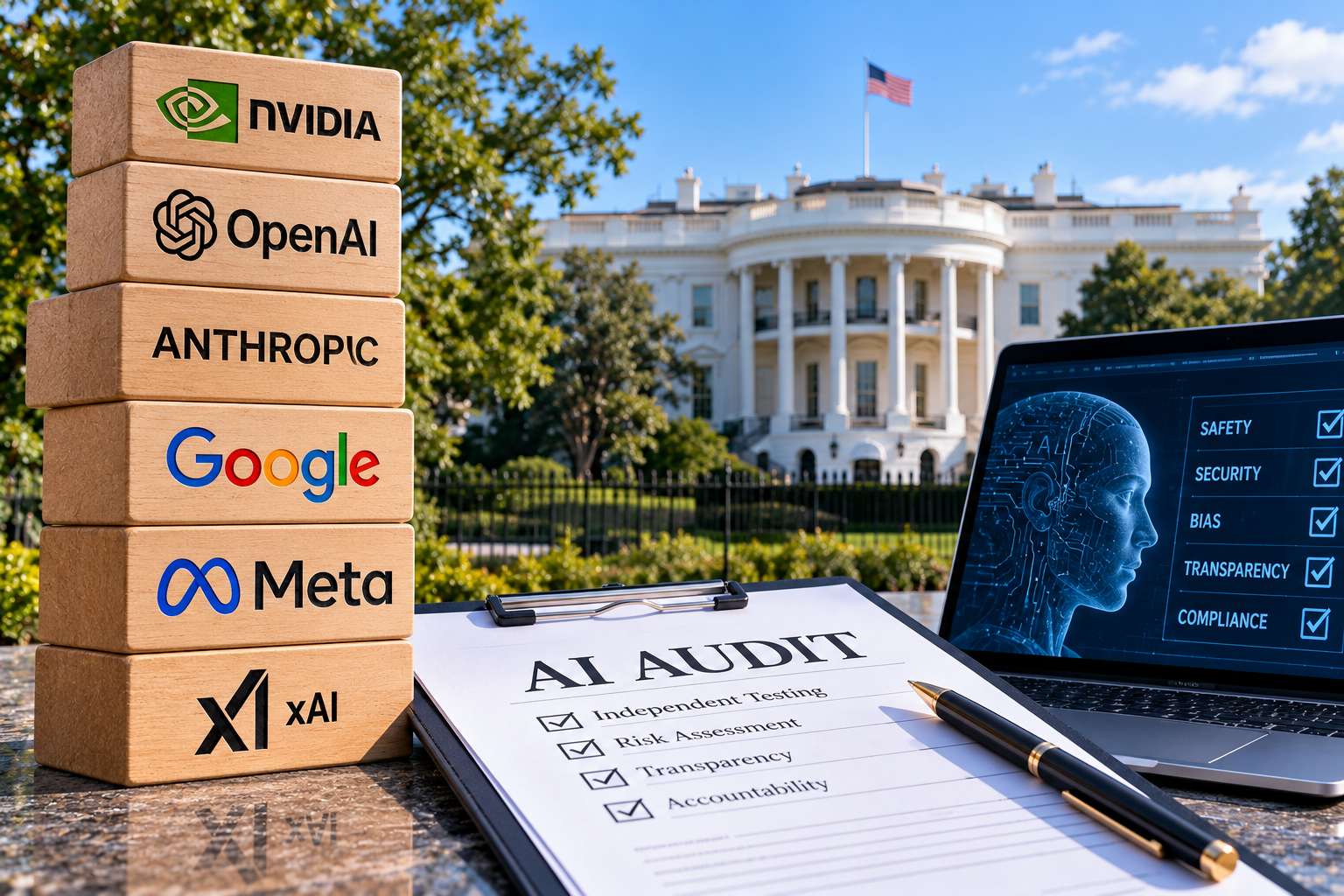
According to a CoinDesk opinion article by Samuel Vance-Law, head of research at the Decentralization Research Center, Nvidia, OpenAI, Anthropic, Google, Meta and xAI signed an accord on advanced AI models on September 29. The companies committed to partnering with independent external auditors or evaluators, with independent board members reviewing reports and ensuring that identified problems are addressed.
However, Vance-Law argues that the accord does not clearly specify who selects the auditors, what they are permitted to test, whether findings must be disclosed publicly or what consequences follow if companies ignore recommendations. Under this arrangement, developers retain substantial influence over the scope of their own evaluations.
For institutions assessing AI-related operational and governance risks, the distinction between an external review and an independently controlled examination is important. An audit may offer limited assurance if the organization under scrutiny determines which questions are asked and which systems are available for inspection.
Past Oversight Failures Highlight the Importance of Incentives
The article draws a comparison with the collapse of Enron and its auditor, Arthur Andersen. Enron paid the accounting firm $25 million for auditing services and another $27 million for tax and consulting work in one year. Following the companies’ collapse, the United States introduced the Sarbanes-Oxley Act, which strengthened auditor independence requirements and established a public board to inspect auditors.
Vance-Law also points to an assessment of voluntary AI commitments made in 2023. Researchers from Stanford, Harvard and Brown evaluated 16 companies against those commitments and recorded an average score of 53%. Eight companies received zero on the commitment to help external researchers find and report problems.
These examples do not establish that AI audits will necessarily fail, but they highlight a recurring governance concern: technical expertise alone may not be sufficient when auditors depend on the organizations they assess for access, information and compensation.
Privacy-Preserving Technology Could Expand Independent Testing
Independent AI testing also presents a technical challenge. Advanced models can cost more than $100 million to develop, and giving external parties complete copies can expose valuable intellectual property and create security risks. Conversely, when companies receive test questions in advance, they may gain visibility into the evaluation process before the assessment takes place.
The article cites a test of OpenAI’s o3 model by the nonprofit organization METR. The evaluation reportedly lasted only three weeks, involved limited access to model information and did not provide visibility into the model’s step-by-step reasoning. The example illustrates how testing constraints can limit what an external assessment establishes.
A different approach emerged in August, when Google DeepMind worked with Singapore’s AI Safety Institute and three other external groups on a double-blind AI evaluation using sealed computer hardware. According to the article, testers could keep their questions private while the model remained hidden from them. Google said the arrangement allowed both sides to verify mathematically that their respective materials remained confidential.
The method still carries security considerations. Vance-Law notes that researchers previously demonstrated attacks against this type of sealed hardware, although physical access to the server was required. Nevertheless, privacy-preserving testing could provide an alternative to choosing between unrestricted model access and limited, developer-controlled evaluations.
Transparency and Accountability Will Shape AI Governance
The Decentralization Research Center’s report, “Alternatives to Concentrated AI,” draws on interviews with 36 people and maps nearly 30 alternatives to concentrated control over AI. Vance-Law argues that independent scrutiny can increasingly occur without auditors taking possession of models or their data.
His proposed reforms include allowing auditors to choose their own tests, requiring companies to identify their auditors and disclose the scope of evaluations, and ensuring that board committees reviewing reports answer to parties outside the companies. He also argues that Congress should consider how to provide independent oversight of the auditors themselves.
Looking ahead, the credibility of AI safety evaluations will depend on whether external reviewers can test meaningful risks without compromising confidential technology. For technology firms, institutional investors and businesses integrating AI into critical operations, the key issue is not simply whether an audit takes place, but whether its scope, independence and findings provide credible evidence of risk management. Clearer standards and verifiable testing procedures could become increasingly important as AI adoption expands.
Comparison, examination, and analysis between investment houses
Leave your details, and an expert from our team will get back to you as soon as possible