Key Points:
- The U.S. Office of the Comptroller of the Currency (OCC) has granted final approval for Ripple National Trust Bank (RNTB), completing a process that began with conditional approval in December 2025.
- The federally supervised trust bank is authorized to manage reserves backing Ripple USD (RLUSD), act as collateral trustee for holders, and provide fiduciary digital-asset custody services.
- RLUSD will continue to be issued by Ripple’s New York-regulated subsidiary, while the new charter adds a federal layer of oversight to the stablecoin’s supporting infrastructure.
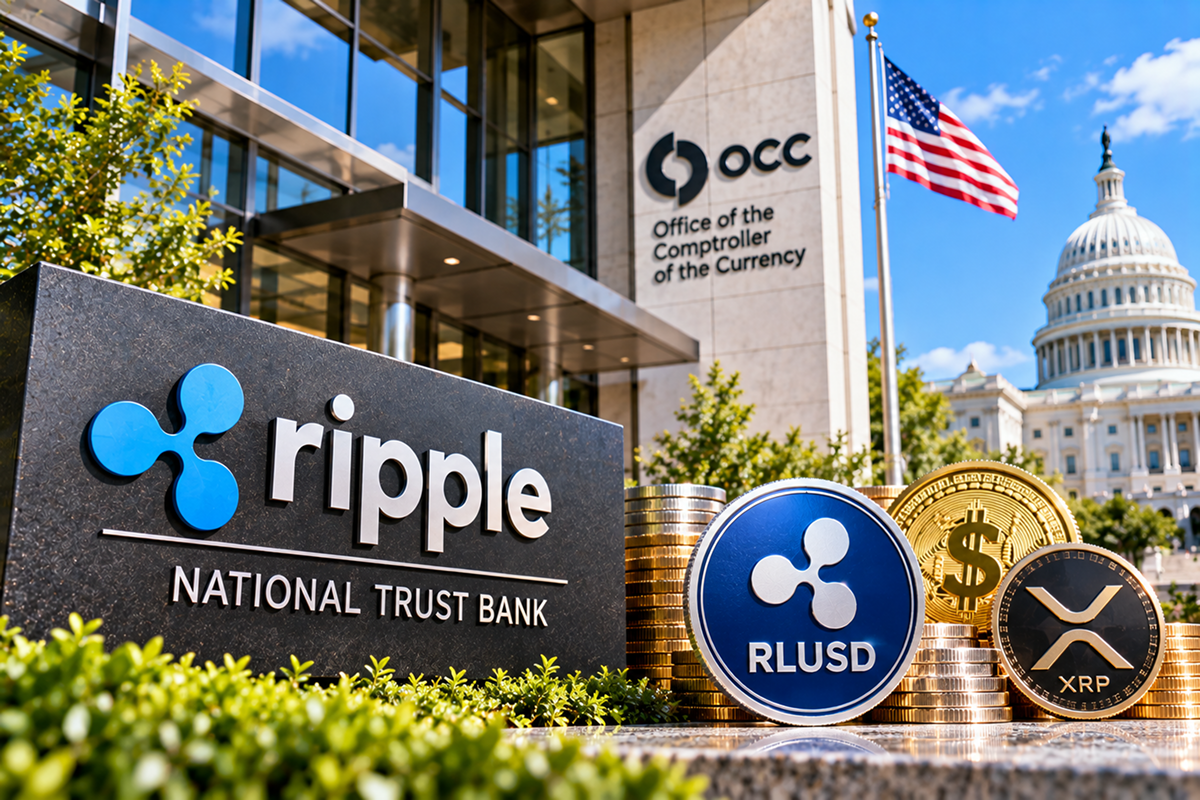
Ripple has received final approval from the U.S. Office of the Comptroller of the Currency to establish Ripple National Trust Bank, marking a significant regulatory development for the company’s institutional digital-asset business. Announced by CEO Brad Garlinghouse on October 26, the decision strengthens Ripple’s position in regulated stablecoin infrastructure and custody services as U.S. authorities develop a clearer framework for integrating digital assets into traditional finance.
Federal Charter Expands Ripple’s Regulated Operations
The OCC’s approval completes the chartering process that began with conditional approval in December 2025. The national trust bank will operate under federal supervision and is authorized to conduct specific fiduciary and custody activities rather than function as a conventional commercial bank.
National trust banks generally focus on holding and managing assets for clients. They are distinct from full-service commercial banks and typically do not accept ordinary deposits or make loans. They also do not automatically carry Federal Deposit Insurance Corporation protection for customer deposits. The distinction is important for institutions evaluating how digital-asset custody and reserve management fit within their existing financial arrangements.
For Ripple, the charter creates a federally supervised structure for supporting institutional services. The approval does not mean that every Ripple product or activity becomes a bank service, nor does it eliminate the need to comply with other applicable regulatory requirements.
RLUSD Reserve Management Gains Federal Oversight
A central responsibility of RNTB will be managing the segregated reserves backing RLUSD, Ripple’s U.S. dollar-pegged stablecoin. The trust bank is also authorized to act as collateral trustee for those reserves for the benefit of RLUSD holders and provide fiduciary digital-asset custody services.
Importantly, RLUSD will continue to be issued by Standard Custody & Trust Company, Ripple’s limited-purpose trust company regulated by the New York State Department of Financial Services. The new federal charter therefore adds another layer of oversight without transferring stablecoin issuance to RNTB.
Ripple reported that RLUSD, launched in December 2024, had reached a market capitalization of approximately $2.5 billion by October 2026. The company says the token is backed by U.S. dollar deposits, U.S. government securities and other cash equivalents, with BNY serving as its primary reserve custodian. Ripple also publishes monthly independent third-party attestations covering circulating supply and reserve assets.
Federal supervision could strengthen institutional confidence in reserve management and custody arrangements. However, market participants will still need to assess redemption procedures, operational controls, transparency and the risks associated with stablecoin infrastructure.
Competition for Institutional Crypto Services Intensifies
Ripple’s approval comes amid a broader effort by digital-asset firms to obtain federal trust-bank charters. Circle, the issuer of USDC, received final OCC approval in July 2026, while other crypto companies have pursued similar authorizations. The trend suggests that regulated custody and stablecoin reserve management are becoming increasingly important areas of competition.
For institutional clients, federally supervised providers may offer a clearer regulatory framework for integrating digital assets into payments, treasury operations and collateral management. Yet a charter alone does not guarantee commercial adoption. Providers must still demonstrate reliable technology, competitive pricing, robust controls and the ability to meet institutional service requirements.
For the wider crypto market, Ripple’s approval is primarily a regulatory and infrastructure development rather than a direct indicator of XRP’s price trajectory. RLUSD, XRP and Ripple’s institutional services have distinct functions, and the bank’s authorization does not guarantee increased demand for the XRP token.
The next milestones will be RNTB’s operational launch, the rollout of its custody services and its ongoing coordination with the OCC and New York regulators. Investors will also be watching whether regulated stablecoin infrastructure attracts additional institutional clients and supports wider adoption of blockchain-based payments. The long-term significance will depend on execution: the charter creates new capabilities, but commercial results will determine how materially it strengthens Ripple’s position in digital finance.
Comparison, examination, and analysis between investment houses
Leave your details, and an expert from our team will get back to you as soon as possible