Key Points:
- DeepSeek is seeking at least $12 billion in fresh funding, potentially reaching $15 billion, as it prepares for a possible Shanghai listing and targets a valuation of roughly $74 billion.
- Moonshot AI has reached a $50 billion valuation and is preparing for a potential Hong Kong IPO that could raise as much as $5 billion in the first quarter of 2027.
- OpenAI is also attracting enormous private capital, with SoftBank completing a $30 billion investment, underscoring the scale of the capital race surrounding advanced AI.
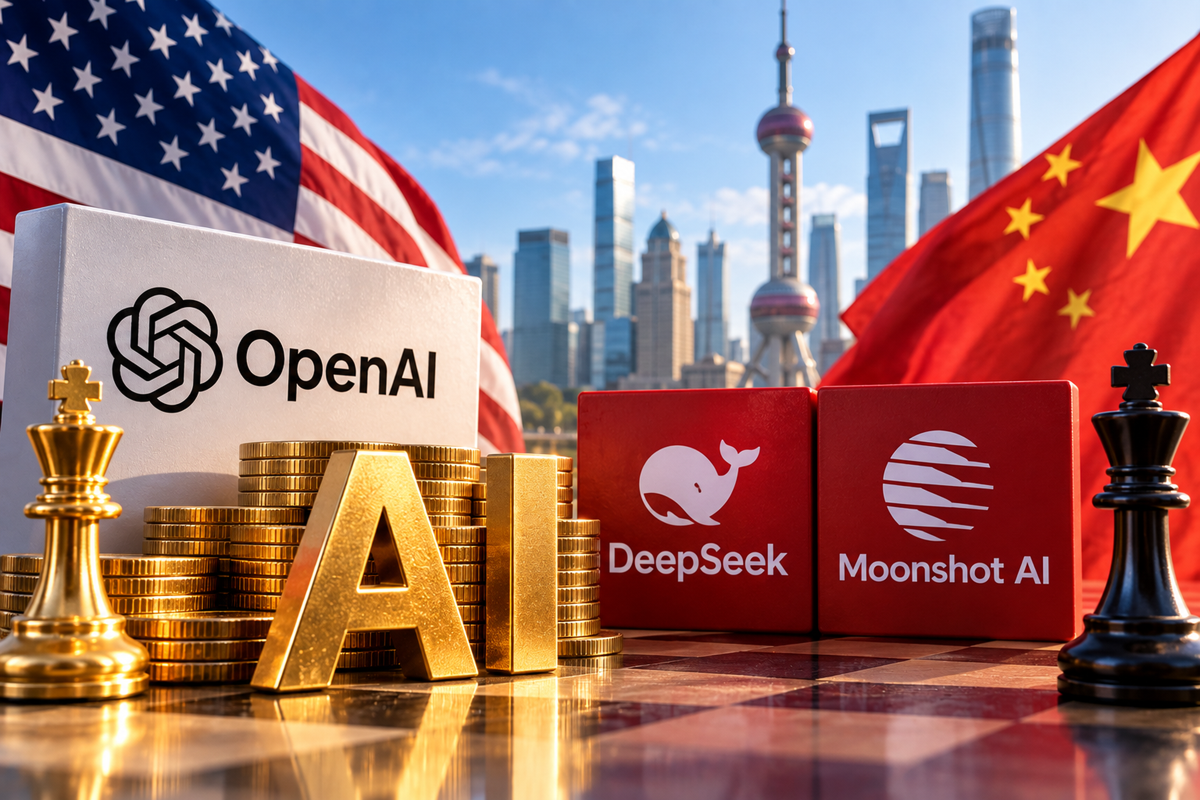
The global artificial-intelligence race is increasingly becoming a competition for capital as well as computing power. Chinese AI developers DeepSeek and Moonshot AI are securing billions of dollars ahead of potential public listings, while U.S. leader OpenAI continues to attract institutional funding at a scale that could reshape how investors allocate capital across technology, semiconductors, data centers and other high-growth sectors.
DeepSeek Pushes Funding Expectations Higher
DeepSeek is close to securing at least 80 billion yuan, or about $12 billion, in its latest funding round, according to people familiar with the matter. The company initially sought approximately 50 billion yuan, but investor demand following the release of its latest model has pushed expectations higher, with the round potentially approaching 100 billion yuan, or roughly $15 billion.
The company is reportedly targeting a valuation of approximately 500 billion yuan, or $74 billion, while preparing for a potential domestic IPO. DeepSeek’s fundraising illustrates how China’s AI sector is moving from relatively concentrated private financing toward larger pools of institutional and strategic capital, with Tencent and battery manufacturer CATL among the major investors in the latest round.
Moonshot Moves Toward the Public Markets
Moonshot AI is following a different route, positioning itself for a potential Hong Kong IPO in the first quarter of 2027. The company has completed a private funding round valuing it at approximately $50 billion, up significantly from the $31.5 billion valuation reported in an earlier summer financing round. The potential offering could raise as much as $5 billion.
Moonshot’s rapid valuation expansion reflects growing investor interest in Chinese AI models, particularly following the July launch of its Kimi K3 model. Its annual recurring revenue has reportedly reached approximately $1 billion, with expectations of reaching $2 billion by December.
For global investors, these prospective listings could provide a clearer market-based comparison between Chinese and U.S. AI companies, while also testing whether private-market valuations can withstand public-market scrutiny.
OpenAI Shows the Scale of the U.S. Capital Race
The capital requirements are not confined to China. SoftBank completed a $30 billion investment in OpenAI on October 1, one of the largest individual commitments in the AI sector. SoftBank had separately arranged an $11 billion bond offering to help fund its investment, highlighting how AI financing increasingly extends into broader capital markets.
The scale of these transactions matters for crypto investors because AI and digital assets increasingly compete for the same pools of institutional risk capital. At the same time, AI’s demand for computing infrastructure, electricity and advanced chips creates investment cycles that can influence semiconductor, energy and data-center markets—sectors that increasingly overlap with crypto mining and high-performance computing.
Capital Intensity Becomes the Key Test
The emerging AI funding race is ultimately a test of whether extraordinary capital commitments can translate into sustainable revenues and productivity gains. Global data-center spending is projected to become enormous over the coming decades, while major AI developers continue signing large infrastructure commitments.
For sophisticated investors, the next stage will be watching IPO pricing, revenue growth, capital expenditure and cash requirements rather than headline valuations alone. If Chinese AI firms successfully access public markets while U.S. companies sustain their funding momentum, AI could continue absorbing substantial global capital. That dynamic may influence liquidity available across other technology and alternative-asset markets, including crypto, making the AI funding cycle an increasingly relevant macro variable for digital-asset portfolios.
Comparison, examination, and analysis between investment houses
Leave your details, and an expert from our team will get back to you as soon as possible