Key Points:
- Gemini Space Station’s market value has fallen to about $753 million, roughly 80% below its public-market debut, as trading activity, revenue and platform assets have declined.
- The company’s regulatory licenses, custody infrastructure and customer relationships could be more strategically valuable to an acquirer than its shrinking spot-exchange business.
- Gemini’s concentrated ownership structure gives Cameron and Tyler Winklevoss 94.5% of voting power, making any potential transaction heavily dependent on their approval.
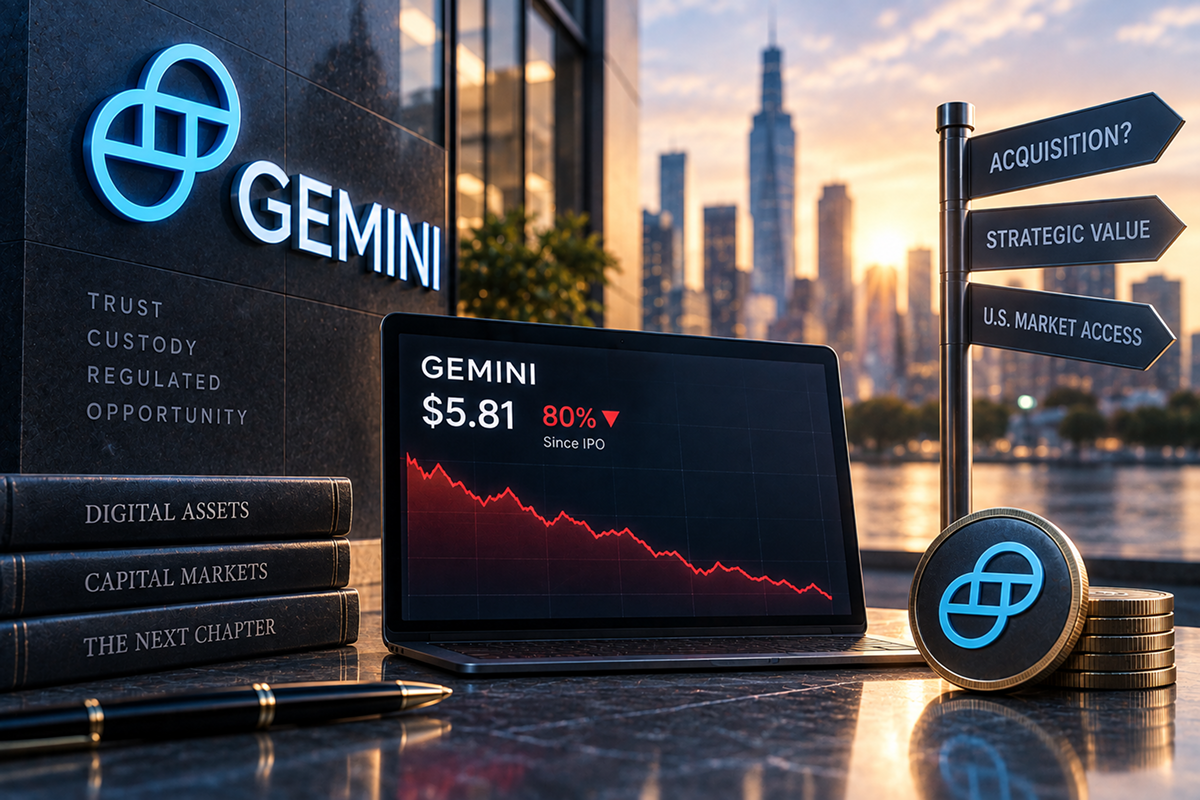
Gemini Space Station’s sharp decline since its 2025 IPO is putting the U.S. crypto platform back into discussions about strategic consolidation. The stock closed at $5.81 on Sept. 18, compared with its $28 IPO price, while the company’s market capitalization stood near $753 million, creating a valuation that could attract attention from crypto firms seeking regulated infrastructure and established U.S. market access.
Gemini’s Market Value Has Contracted Sharply
Gemini priced its initial public offering at $28 per share in September 2025, with 15.94 million Class A shares sold after the underwriters exercised their full over-allotment option. By Sept. 18, 2026, the stock had fallen to $5.81, representing a decline of roughly 79% from the IPO price. The company’s market capitalization had fallen to approximately $753 million, compared with roughly $4 billion at its peak, according to CoinDesk.
The decline has coincided with weaker operating activity. Gemini’s second-quarter exchange revenue fell 38% year over year to $12.5 million, while spot trading volume dropped 66% to $3.8 billion. Assets held on the platform declined to $8.4 billion from $18.2 billion, highlighting the pressure on the core exchange operation.
Regulatory Infrastructure Could Become the Strategic Asset
The deterioration in trading activity does not necessarily eliminate Gemini’s strategic value. Through its subsidiaries, the company holds regulatory licenses and approvals that potential competitors could otherwise spend years and significant legal resources obtaining. For an acquirer seeking a regulated U.S. foothold, those permissions could represent a more durable asset than Gemini’s declining spot-trading volumes.
That dynamic reflects a broader shift in crypto mergers and acquisitions. Buyers are increasingly examining regulatory access, institutional distribution, custody capabilities and market infrastructure alongside revenue. CoinDesk cited recent transactions involving Keyrock and BlockFills, as well as strategic discussions involving other digital-asset companies, as examples of businesses expanding through acquisitions rather than building every regulated capability internally.
Hyperliquid Proposal Highlights the M&A Logic
The takeover discussion was partly revived by Lorenzo Valente, director of digital assets research at ARK Invest, who proposed that Hyperliquid could acquire Gemini and use the company as a regulated U.S. gateway for products including perpetual futures and prediction markets. There is no indication that Hyperliquid is actively pursuing such a transaction, making the proposal an analytical scenario rather than evidence of an ongoing bid.
For potential buyers, Gemini’s valuation creates an important comparison between the cost of acquisition and the expense of developing a regulated platform independently. At approximately $753 million in equity value, an acquirer could gain access to licenses, custody infrastructure and an established customer base, although the declining operating metrics would also need to be considered in any valuation.
Winklevoss Control Is Both an Asset and Constraint
Ownership structure represents another central factor. Cameron and Tyler Winklevoss collectively control approximately 94.5% of Gemini’s voting power. That concentration could make negotiations more straightforward because a transaction would effectively depend on agreement from two principal decision-makers.
At the same time, the structure significantly limits the possibility of a hostile transaction or shareholder-driven sale. Any prospective acquirer would therefore need to establish a strategic and financial case that satisfies the company’s controlling shareholders, rather than relying primarily on market pressure.
What the Market Will Watch Next
Gemini’s next phase will depend on whether management can stabilize exchange activity and platform assets or whether its regulated infrastructure increasingly becomes the focus of strategic interest. With the stock trading far below its IPO price and the crypto industry continuing to consolidate around regulated access, potential M&A interest, operating trends and regulatory-license valuations will be important indicators of how the market ultimately values Gemini’s business.
Comparison, examination, and analysis between investment houses
Leave your details, and an expert from our team will get back to you as soon as possible