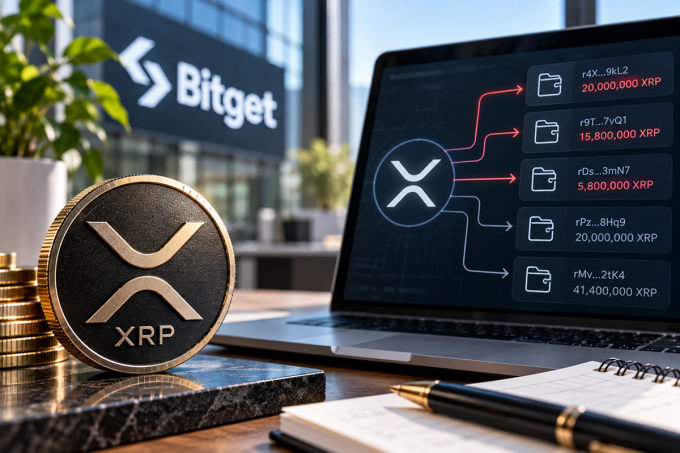
XRP ETFs have accumulated roughly 930 million tokens, removing a meaningful amount of XRP from immediately tradable supply, yet the expected price squeeze has not materialized. XRP was trading around $1.01 in the data supplied for the report, down 6.3% over the past week and 8.2% over the past month, highlighting the gap between headline ETF accumulation and the amount of fresh demand actually entering the market.
ETF Holdings Are Large but Still Small Relative to XRP Supply
The approximately 930 million XRP held by ETFs represents only about 1.5% of the roughly 62.5 billion XRP in circulation. That distinction is important: while the tokens are held in custody rather than actively circulating through the market, the locked balance remains relatively small compared with the overall supply available to investors. Current market data puts circulating supply at approximately 62.53 billion XRP.
The scale of the ETF accumulation is nevertheless significant. U.S. spot XRP ETFs had attracted about $1.49 billion in cumulative net inflows by July, although nearly 80% of that amount arrived during the first two months after their November 2025 launch. Fund assets stood near $991 million as XRP prices declined, illustrating how falling token prices can offset the impact of positive fund flows.
Ripple’s Escrow System Complicates the Supply-Squeeze Thesis
The core problem for the supply-squeeze argument is that ETF accumulation is occurring against a token supply structure that includes Ripple’s escrow holdings. The description supplied for the report estimates that Ripple releases 300 million XRP per month on a net basis after the scheduled escrow process, meaning ETF purchases must consistently exceed this additional supply pressure before the effect becomes structurally significant.
On-chain supply data illustrate the scale involved. A July report tracking XRP’s ledger showed Ripple’s escrow holdings at approximately 32.44 billion XRP, equivalent to roughly 32.4% of the fixed 100 billion XRP supply, although unused portions of scheduled releases can be placed back into escrow.
ETF Demand Has Lost Momentum
The more immediate issue is not simply how many XRP the ETFs already hold, but whether they are continuing to acquire tokens at a pace capable of influencing marginal price discovery. The supplied data indicate that monthly ETF inflows fell from approximately $650 million in November 2025 to about $1 million in August 2026, a dramatic reduction in new demand.
That slowdown is consistent with broader evidence of weakening ETF activity. By July, cumulative inflows remained positive, but monthly demand had fallen to approximately $4.28 million, with nearly 80% of cumulative inflows having arrived during the first two months of trading. This suggests that the existing supply lock is becoming less important at the margin because fewer new dollars are arriving to purchase additional XRP.
CLARITY Act Could Change the Demand Equation
Regulatory clarity remains a potential catalyst because institutional demand depends not only on the availability of ETF products but also on confidence around XRP’s legal classification. Standard Chartered has estimated that spot XRP ETFs could attract $4 billion to $8 billion in inflows if the CLARITY Act becomes law.
At the upper end of the demand scenarios described in the source material, sustained ETF inflows could become large enough to materially exceed the roughly 300 million XRP of monthly net supply associated with Ripple’s escrow program. The significance would be less about a fixed number of tokens being locked away and more about whether persistent institutional demand begins to absorb new supply faster than it enters the market.
Looking ahead, the XRP market needs sustained incremental demand rather than simply a large existing ETF balance. The key indicators will be monthly ETF creations, XRP’s circulating supply, Ripple’s net escrow releases and progress toward U.S. regulatory clarity. Until those forces move decisively in the same direction, the roughly 930 million XRP held by ETFs may remain an important structural development without being sufficient on its own to generate the price squeeze investors have anticipated.
Comparison, examination, and analysis between investment houses
Leave your details, and an expert from our team will get back to you as soon as possible